Chapter 1:
Introduction of Bismark Chain Coupling Machine
1.1 Early Development of Bismark Chain Coupling Machine
The origin of the Bismark Chain Coupling Machine can be traced back to the gradual upgrading stage of the jewelry manufacturing industry. Initially, connecting jewelry chains mainly relied on manual welding. This method had low efficiency, producing only a few dozen to a hundred chains per day, and the quality was unstable. Weld seams often had issues such as unevenness and insufficient firmness, seriously limiting the development of the jewelry industry.
With the continuous growth of market demand for jewelry chains, there was an urgent need for automated equipment to replace manual operations. Against this background, the prototype of the Bismark Chain Coupling Machine emerged. Early machines had relatively simple structures with basic chain connection and welding functions, achieving only 50–100 welds per minute. However, they laid the foundation for subsequent technological innovation and upgrades in chain coupling equipment.
1.2 Modern Bismark Chain Coupling Machine Technology
Modern Bismark Chain Coupling Machines have achieved a comprehensive technological leap, integrating multiple advanced technologies to create highly automated and precise production equipment.
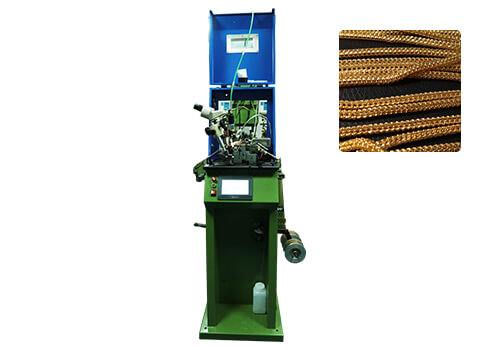
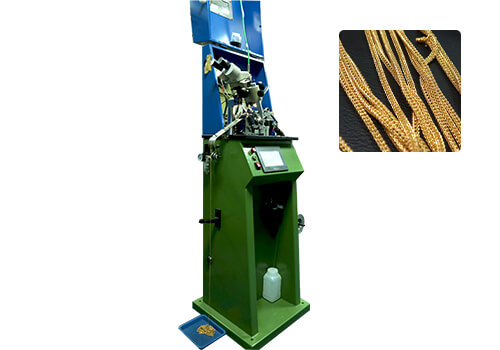
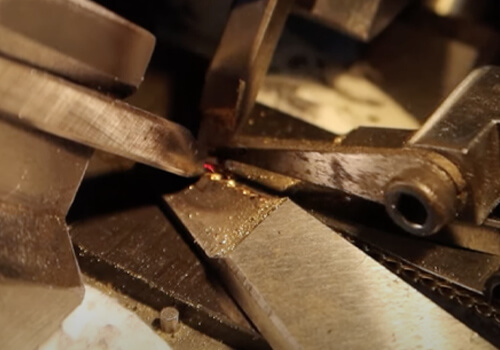
Core components: High-performance laser welding systems with high energy density and fast welding speed. For example, the Superbmelt Bismark Chain Coupling Machine reaches up to 500 welds per minute, dozens of times faster than early machines.
Control system: Equipped with a PLC control unit and a touch screen interface. Operators can preset welding parameters according to chain materials and specifications, allowing intelligent process adjustment.
Auxiliary modules: Features such as binocular microscopes for clear observation of welding, and sensor detection units to monitor the machine’s status in real time and issue early warnings for malfunctions, ensuring stable and continuous production.
1.3 Application History in the Jewelry Industry
Since its inception, the Bismark Chain Coupling Machine has become key equipment in the jewelry industry. Initially used mainly for high-end gold and silver chains, it helped large jewelry brands overcome low efficiency and inconsistent quality in mass production. With technological advancement and lower equipment costs, its application expanded to small and medium-sized processing plants and custom studios. Recently, with the rise of fashion jewelry, it has further broadened its application to various metals, such as stainless steel and copper, serving multiple market segments including fashion and religious jewelry. It is now indispensable in modern chain production.
1.4 Core Performance Advantages
Compared to traditional chain connection equipment and manual operations, Bismark Chain Coupling Machines offer significant advantages:
Material protection: Precise laser welding minimizes damage to metal ductility, preserving flexibility and wear resistance.
Efficiency: High-speed welding significantly increases production capacity.
Product quality: Standardized welding ensures consistent quality with over 99% product qualification.
Ease of use: Simple interface and low maintenance reduce operational barriers, allowing rapid deployment and benefits.
Chapter 2:
Types of Bismark Chain Coupling Machines on the Market
2.1 High-Speed Bismark Chain Coupling Machine
Designed for large-scale jewelry manufacturers requiring high production capacity. Features include:
Maximum welding speed of 500–600 welds per minute.
High-power laser system and optimized chain transmission mechanism for continuous, efficient production.
Ideal for mass production of conventional chains like polished stainless steel 2mm 18-inch Bismark chains.
Example: Superbmelt high-speed model, enabling rapid completion of large orders.
2.2 Precision Bismark Chain Coupling Machine
Focuses on high-end customized chains requiring precise welding and flawless appearance:
Advanced laser focusing and positioning systems for tiny chain nodes.
Smooth, beautiful weld seams without visible marks.
Equipped with high-definition binocular microscope for detailed observation.
Suitable for high-end gold/silver chains and complex designs like double-knot pearl chains or special-shaped curb chains.
2.3 Multi-Material Adaptable Bismark Chain Coupling Machine
Designed for versatility across different metals:
Handles gold, silver, stainless steel, copper, aluminum, etc.
Replaceable welding head and adjustable parameters for different materials.
Suitable for enterprises producing multiple types of chains, reducing equipment replacement costs and improving efficiency.
Chapter 3:
Why Bismark Chain Coupling Machine is Needed
3.1 Development History of Chain Production Technology
Chain production evolved through manual, semi-automatic, and fully automatic stages. Manual production was labor-intensive and low efficiency. Semi-automatic production still required manual welding, limiting output. With higher consumer demand for chain variety and quality, traditional methods could not meet market needs. Bismark Chain Coupling Machines enabled full automation, achieving leaps in production efficiency and quality.
3.2 Market Demand and Chain Product Sources
Global jewelry demand is steadily growing, from luxury to daily fashion chains. Professional processing bases and manufacturers must meet high-volume, multi-variety, high-quality requirements. Bismark Chain Coupling Machines help efficiently meet these market demands and enhance competitiveness.
3.3 Supporting Equipment for Chain Production
Bismark machines are core but require complementary equipment:
Wire drawing machine: Produces raw wire of specified size.
Weaving machine: Creates different chain styles.
Polishing machine: Enhances chain surface finish.
Testing equipment: Ensures chain quality meets standards.
Together, these enable automated production from raw wire to finished chain.
3.4 Choosing Supporting Accessories
Accessory selection affects efficiency and quality:
Welding head: Low-power, high-precision for gold/silver; high-power for stainless steel.
Sensors and microscopes: High-sensitivity sensors detect malfunctions; high-definition microscopes aid observation.
Ensure compatibility and after-sales support for stable operation.
Chapter 4:
How to Obtain High-Quality Finished Chains
4.1, Refining and Pretreatment of Materials
Precious metals: Smelting and purification remove impurities and improve purity.
Common metals: Surface treatment like derusting and degreasing ensures smooth welding and firm seams.
Material quality directly impacts welding and finished chain performance.
4.2, Welding Parameter Optimization
Adjust laser power, speed, and duration according to material, thickness, and style.
Example: Thin gold chains require low power and slow speed; thick stainless steel chains require higher power.
Continuous monitoring and parameter adjustment ensure weld consistency.
4.3, Post-Processing
Polishing removes burrs and oxides, creating a smooth, shiny surface.
Electroplating enhances corrosion resistance, decorative effect, and color options.
Cleaning removes residual impurities for safety and environmental compliance.
Quality Inspection
Inspect appearance (weld marks, burrs, scratches), size (length, width, thickness), and firmness (tensile strength, wear resistance).
Rework or scrap unqualified products to ensure only high-quality chains reach the market.
Chapter 5:
Application in Different Scenarios
5.1 Differences from Other Chain Welding Equipment
Laser welding provides higher energy density, precision, smoother and firmer welds, and minimal material damage.
Automated operation and high-speed welding surpass traditional flame or resistance welding.
Simple operation and low maintenance increase competitiveness.
5.2 Optimal Applications in Different Industries
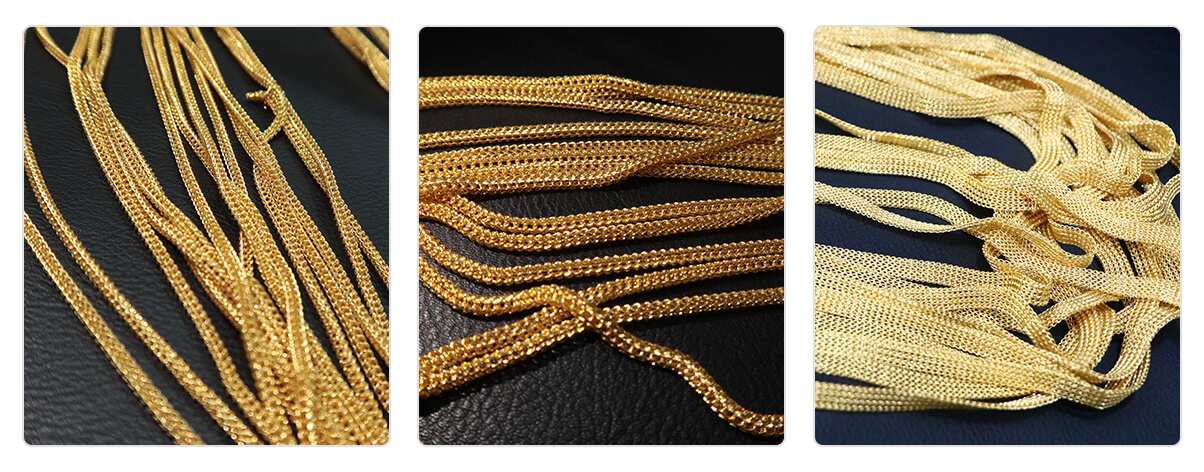
Jewelry: Pearl chains, box chains, curb chains; high-end or fashion jewelry.
Hardware: Key chains, decorative chains.
Automotive: Small chains for seats, decorations.
Equipment parameters must be adjusted for each industry’s specific needs.
5.3 Choosing the Most Suitable Machine
Consider production scale, product positioning (high-end custom vs. mass-produced), and material types.
Multi-material adaptable machines suit diverse metal production.
Evaluate supplier brand, after-sales service, and equipment price for long-term needs.
5.4Maintenance and Upgrading
Daily maintenance: Clean equipment, check welding heads and sensors, maintain lubrication.
Upgrading: Monitor technological trends, update control systems and components to improve performance and efficiency.
5.5 How Much Does a Bismark Chain Coupling Machine Cost?
he price of a Bismark chain coupling machine varies depending on welding speed, precision level, and material compatibility:
- – High-Speed models, optimized for maximum throughput (up to 500 welds per minute), are priced based on production capacity and automation level.
- – Precision models, built for fine, high-value chains, carry a premium for their enhanced accuracy and control.
- – Multi-Material models, capable of welding gold, silver, stainless steel, copper, and aluminum, are typically positioned as the most versatile — and most flexible — investment for workshops handling diverse chain types.
Because pricing depends on your specific production volume, chain material, and required automation level, we recommend requesting a customized quote based on your workshop’s needs. Contact SuperbMelt for a free, no-obligation price quote tailored to your production requirements.
The Bismark Chain Coupling Machine is core equipment in modern jewelry chain production, driving industry transformation with advanced technology, high efficiency, and precision. From its early development to continuous innovation, it meets changing market demands and has become indispensable in jewelry and related industries.
With increasing consumer demand and higher quality requirements, its application prospects are broad. Choosing the right machine and maintaining it properly improves efficiency, quality, competitiveness, and sustainability.
Future developments with AI and IoT will make Bismark machines smarter, more precise, and multi-functional, bringing further opportunities and contributions to chain production and related industries.






 © Copyright 2008-2026 Superb Electromachinery Co., Limited