
Portable Laser Welding Machine
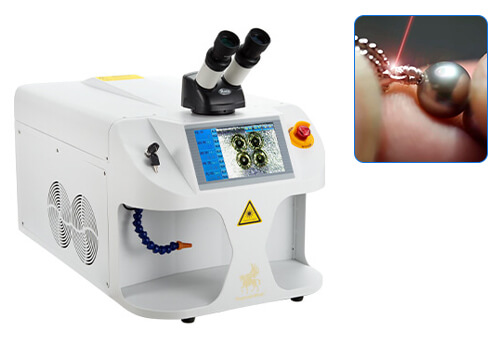
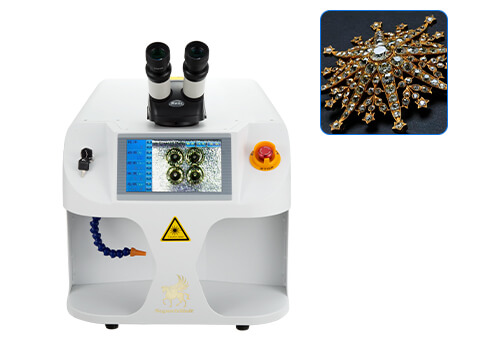
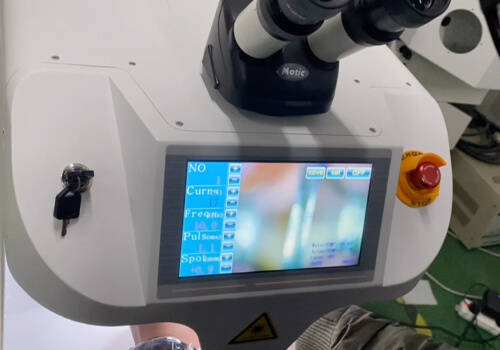
SuperbMelt’s SPB-150WB laser welding machine welds precious metals including karat gold, sterling silver, platinum, and palladium with precision suited for jewelry repair, custom fabrication, and antique restoration. The integrated microscope and camera system allow operators to position and control the weld point with full visibility throughout the process.
Unlike traditional torch soldering, this fiber laser produces a clean, smooth weld with no discoloration on or around the weld spot, and welds small, complex, or dissimilar metal parts that would be difficult or impossible with conventional jewelry repair methods.
SuperbMelt has 15+ years of experience manufacturing gold and jewelry machinery, with ISO, CE, and SGS certifications. Contact us today for pricing and a technical consultation for your specific repair or production needs.
| Model | SPB-150WB |
| Wavelength | 1064nm |
| Max output power | 150W |
| Max pulse energy | 80J |
| Pump source | Single lamp |
| Pulse width | 0.1-20ms |
| Pulse frequency | ≤50Hz |
| Aiming and positioning | Microscope + camera system |
| Application | Welding and repairing various precious metal trinkets |
| Host power consumption | ≤5KW |
| Electricity demand | AC220V±5%/50Hz |
| Cooling system | Water cooling + air cooling |
| Dimension | 660x385x435mm |
| Weight | 49kg |
- Superbmelt portable laser welding machine weld noble metal, karat gold, sterling silver, platinum, palladium, etc, at a wavelength of 1064nm.
- Superbmelt handheld laser welding machine is equipped with a microscope and a camera that allows you to aim and position metal parts during the welding process.
- The handheld laser welding machine guarantees a clean and smooth welding process. When you use a portable laser welding machine, there is no discolouration on the welded spot and surrounding area, compared with the soldering process.
- You can weld small parts, complicated, as well as dissimilar metals together, which would normally be impossible with other jewellery repair processes.
- The portable laser welding machine for sale requires low heat of ≤5kw. The low heat reduces the chances of distortion of metals after welding.
- Superbmelt portable laser welding machine has a water cooling system and air cooling system, to ensure maximum efficiency of welding and regulating heating temperature. This allows you to weld continuously.
- If you have a damaged antique or trinket, a Superbmelt handheld laser welding machine will effortlessly repair it for you.
- The handheld laser welding machine China has an imported ceramic condenser cavity that is both resistant to corrosion and high temperature. The imported ceramic condenser has a lifespan of 8 to 10 years, guaranteeing a long-lasting use of the entire portable laser welding machine.
- Superbmelt laser welding machine for sale is a compact size with a dimension of 660*385*435mm and a total weight of 49kg.
- Superbmelt small laser welding machine is suitable for use in jewelry repair and pawnshops, jewelry making, dental, medical, construction, electronics industries, etc.
- With the portable laser welding machine, there is no need for filler elements when welding your metals.
- The portable laser welding machine for sale guarantees excellent weld quality, clean and smooth welding process.
- The maximum output power and the maximum pulse energy for the portable laser welding machine are 150W and 80J respectively.
- The tightly controlled laser beam allows you to weld the smallest components.
- Superbmelt handheld laser welding machine is ergonomically designed for ease of use. You can conveniently place the portable laser welding machine on any surface proportional to your height.

2 years warranty
The warranty for our machine is one year longer than the warranty provided by other factories.

Strong service team
We will give response within 24 hours against your problem by our professional engineer.

Why SuperbMelt Portable Laser Welding Machine


Any Question About SuperbMelt Portable Laser Welding Machine
Portable Laser Welding Machine: Usage and Buying Guide
With the rapid advancement of laser welding technology, portable laser welding machines have gradually become a “must-have” across multiple industries due to their flexibility and efficiency. From precision work in small workshops to on-site maintenance in large factories, these machines are increasingly in demand. This guide will provide a comprehensive breakdown of portable laser welding machines—from target users, device types, core advantages, and key parameters to application scenarios—helping you accurately determine whether you need one and how to choose the model that best suits your needs.
Which users need a Portable Laser Welding Machine?
Portable laser welding machines are not “universal equipment”; their core value lies in “flexibly adapting to specific scenarios.” For the following types of users, choosing one can significantly improve efficiency and reduce costs:
1.1, Small jewelry/ornament workshops (individual practitioners / teams of ≤3 people)
- Core requirement: Perform precise welding on precious metals such as gold, silver, and platinum (e.g., chain links, pendant setting points), with welds that are hidden and oxidation-free, in a limited workspace (typically 10–20㎡ studios).
- Why a portable model is needed: Traditional desktop laser welding machines are large (occupying 1–2㎡) and difficult to place in small spaces. Portable devices, such as mini spot welders, weigh only 3–5 kg, can be placed on a corner of the workbench, or even moved as needed. They also deliver millimeter-level precision welding (weld diameter 0.1–0.3 mm), minimizing precious metal loss.
Common types of portable laser welding machines
Based on “size, power range, and core application,” portable laser welding machines can be mainly divided into three types. The suitability for different scenarios varies significantly, so it is essential to match the type precisely to your needs.
2.1, Mini jewelry laser spot welding machine (power: 150–300W)
Core Positioning: Fine spot welding for precious metals, representing “small but precise.”
Appearance & Size:
Dimensions: Approximately 30cm × 20cm × 15cm (similar to a microwave), weight 3–8kg, can be placed directly on a desktop without occupying extra space.
Operation Interface: Touchscreen + physical buttons, displays welding power, spot diameter, welding time, and other parameters; supports Chinese/English switching, easy for beginners.
Core Specifications:
Laser Type: Fiber laser (concentrated energy, suitable for precious metals).
Spot Diameter: 0.1–0.5mm (adjustable), can weld fine gold wire as small as 0.05mm.
Welding Thickness: Gold/Silver/Platinum 0.1–2mm, Copper 0.1–1.5mm.
Cooling Method: Air-cooled (no external water needed, suitable for desktop use).
Power Requirement: 220V household power (≤500W), no industrial electricity required.
Applicable Scenarios:
Jewelry: Chain link welding, pendant prong reinforcement, ring resizing and repair.
Precision Electronics: Watch movement component welding, micro sensor terminal welding.
Advantages & Disadvantages:
Advantages: Extremely high precision (no welding marks, no oxidation), minimal size, easy to operate, no professional training required.
Disadvantages: Low power, supports only spot welding (no continuous welding), not suitable for thick metals (>2mm).
Market Price: Entry-level (150W) $3,000–5,000; Professional version (300W, with microscope) $8,000–12,000.
Why are portable devices so popular? Core advantages
Compared to traditional welding equipment (such as arc welders or desktop laser welding machines), the popularity of portable laser welding machines is no coincidence—their core advantages precisely address key pain points in the industry:
3.1, Extremely compact, suitable for “small spaces”
Space Requirement
- Pain Point (Traditional Equipment): Desktop laser welding machines require a fixed space (2–3㎡) with additional room for heat dissipation and operation. Small workshops (10–20㎡) struggle to accommodate them. Arc welding equipment, although smaller, still requires gas cylinders (argon tanks) and cables, taking up significant space.
- Portable Advantage: The smallest mini spot welding machines occupy only 0.01㎡ of desktop space (roughly the size of an A4 sheet). Even the largest micro handheld units have compact main units that fit in a corner, with the welding head extended via fiber optic cable. For example, in a 15㎡ jewelry workshop, you could fit 2 mini spot welders plus 1 workbench, improving space utilization by 50%.SuperbMelt’s SPB-150WB measures 660×385×435mm — fits on a standard workbench in jewelry workshops without requiring a dedicated room.
3.2, Highly mobile, overcoming the “fixed workstation” limitation
Mobility
- Pain Point (Traditional Equipment): Most traditional equipment is fixed (desktop machines need fixed power and water supply, arc welding gas cylinders are cumbersome). Welding large workpieces (e.g., 3-meter steel structures) or performing on-site repairs requires disassembly and transport, which is labor-intensive (2–3 people, 2–4 hours).
- Portable Advantage: Mini units are hand-carriable (3–8kg), desktop models with wheels (15–30kg) can be moved by one person, and handheld units (20–40kg) can be transported in a vehicle (e.g., SUV trunk), with fiber-optic welding heads for flexible operation. For example, a hardware repair team can weld a stainless steel sink on-site with just one handheld unit and a portable power source, completing setup in 30 minutes and improving efficiency 3–4 times.
3.3, Low operating threshold, easy for beginners to learn quickly
Ease of Use
- Pain Point (Traditional Equipment): Arc welding requires professional training (3–6 months) to avoid burn-through or weak welds. Desktop laser welders, although precise, have complex parameters (laser power, focus, welding speed, 10+ settings) that are difficult for beginners.
Portable Advantage:
Simplified Operation: Mini spot welders have preset “jewelry welding modes,” requiring only selection of weld spot diameter (0.1/0.3/0.5mm) and one-button start. Desktop models provide scenario-based parameters (e.g., “hardware welding,” “electronics welding”) without manual adjustments.
Safety Design: Equipped with laser safety goggles, overload protection (auto shutdown for unstable voltage), and heat-resistant casing, making it safe for beginners.
Learning Curve: Mini units: 1–2 hours to proficiency; desktop: 1–2 days; handheld: 3–5 days (mainly practicing hand stability), significantly shorter than traditional equipment.
3.4, High welding precision, reducing “rework and material waste”
Precision and Material Efficiency
- Pain Point (Traditional Equipment): Arc welding has a large heat-affected zone (5–10mm), easily deforming workpieces (thin stainless steel sheets warp) with rough welds requiring post-grinding. Desktop laser welders, though precise, struggle with micro workpieces (e.g., 0.1mm gold wire), resulting in 5–8% precious metal loss.
Portable Advantage:
High Precision: Mini spot welders have a minimum weld spot of 0.1mm and heat-affected zone ≤0.3mm. No post-grinding is needed, and precious metal loss drops to 1–2% (e.g., 18K gold chains save $10–15 per meter).
Consistency: Desktop units with workbench clamps achieve ±0.01mm positioning accuracy. In batch welding (e.g., 100 identical hardware pieces), weld deviation ≤0.05mm, with a pass rate above 99%, avoiding rework.SuperbMelt’s SPB-150WB achieves these precision benefits with a microscope and camera-assisted aiming system for accurate weld placement.
3.5, No complex supporting equipment required, lowering “startup costs”
Setup and Operating Costs
- Pain Point (Traditional Equipment): Desktop laser welders require industrial power (380V), water cooling (external pipes), and exhaust systems, costing $5,000–10,000 for setup. Arc welding consumes electrodes and argon gas regularly, costing $1,000–2,000 per month.
Portable Advantage:
Simple Setup: Mini units need only 220V household power (≤500W) with air cooling; desktop units have built-in water tanks (no external water needed) and run on 220V; handheld units may require 380V but can use a 5kW generator ($2,000–3,000) without industrial power modification.
Lower Consumables: The main consumable is the protective lens (replaced every 3–6 months, $50–200). No electrodes or frequent argon gas use. Monthly consumable costs are $100–300, 70–80% lower than arc welding.
Key parameters of portable laser welding machines
When choosing a portable laser welding machine, higher specs are not always better—it’s about matching your needs. The following six key parameters directly determine whether the equipment can meet your usage scenarios and should be given close attention:
4.1, Laser power: determines “maximum weldable thickness”
Power
Core logic: Higher power allows welding thicker metals, but excessive power increases energy consumption and enlarges the device (reducing portability).
Parameter selection guide:
For precious metals (gold/silver/platinum ≤2mm) or electronic components (≤1mm): choose 150–300W (mini spot welder); too high power may burn through the workpiece.
For hardware parts (stainless steel/aluminum 0.5–5mm): choose 300–1000W (desktop type), balancing precision and efficiency.
For thick metals (stainless steel >5mm, aluminum >3mm) or outdoor maintenance: choose 1000–2000W (handheld type) to ensure strong welds.
Note: Some manufacturers indicate “peak power” (e.g., “300W peak”), while the actual average power may be only 200W. Confirm average power to avoid being misled.SuperbMelt’s SPB-150WB delivers 150W average power with 80J max pulse energy — suited for precious metal jewelry components and repairs up to 2mm thickness, per the guide above.
4.2, Spot diameter / welding speed: determines “precision and efficiency”
Weld spot diameter & welding speed
Core logic: Smaller spot diameter → higher precision (for micro workpieces); faster welding speed → higher efficiency (for batch production). Balance according to your needs.
Parameter selection guide:
Jewelry/electronics (fine welding required): spot diameter 0.1–0.5mm, mainly spot welding; speed not critical.
Small-batch hardware production (balance precision & efficiency): spot diameter 0.5–1mm, continuous welding speed 1–3 m/min (e.g., weld 1m stainless steel part in 3–5 min).
Outdoor maintenance / large-scale production (efficiency priority): spot diameter 1–2mm, continuous welding speed 3–5 m/min to shorten operation time.Refer to SuperbMelt technical support for the specific spot diameter range available on the SPB-150WB for your jewelry repair application.
4.3, Laser type: determines “welding quality and compatible materials”
Laser type
Core logic: Different laser types have different energy density and wavelength, affecting suitable materials and weld quality.
Comparison & selection:
| Laser type | Energy density | Suitable materials | Weld quality | Typical scenarios |
|---|---|---|---|---|
| Fiber laser | High | Gold, silver, platinum, stainless steel, aluminum, copper | Small spot, no oxidation, high strength | Jewelry, hardware, electronics, outdoor maintenance |
| YAG laser | Medium | Stainless steel, thin copper | Slightly larger spot, prone to oxidation | Low-end electronics, DIY (being phased out) |
| CO2 laser | Low | Rarely used for metals | Poor effect, prone to deformation | Not recommended for metal welding |
Conclusion: Fiber laser is the preferred type—wide material compatibility and excellent weld quality; the mainstream choice for portable devices.The SuperbMelt SPB-150WB uses fiber laser technology — the recommended type for jewelry and precious metal applications per the comparison above.
4.4, Cooling method: determines “flexibility of usage scenarios”
Cooling method
Core logic: Laser welding generates heat; cooling method affects whether external support (water, power) is needed.
Comparison & selection:
| Cooling type | Principle | Advantages | Disadvantages | Typical scenarios |
|---|---|---|---|---|
| Air cooling | Fan dissipates heat | No water, small size | Weak cooling, supports ≤300W | Mini spot welder (jewelry, electronics) |
| Water cooling | Water circulation in tank | Strong cooling, supports 300–2000W | Needs refill every 4–8h, risk of leakage | Desktop & handheld (hardware, outdoor maintenance) |
Selection advice: For locations without water (outdoor or client sites), choose water-cooled devices with large built-in tanks (≥10L) to avoid frequent refills. For desktop use, air-cooling (low power) or small tank water-cooling (high power) is fine.The SPB-150WB uses a combined water-cooling + air-cooling system, supporting the higher pulse energy (80J) required for jewelry workshop production volumes.
4.5, Power requirements: determines “whether it can be used in the target environment”
Power supply requirements
Core logic: Different power levels require different voltage and current; ensure your site can meet the requirement.
Comparison & selection:
| Device type | Power range | Power requirement | Suitable scenarios | Notes |
|---|---|---|---|---|
| Mini | 150–300W | 220V household (≤500W) | Home studio, small workshop | Plug into regular socket, no electrical modification needed |
| Desktop | 300–1000W | 220V/380V optional (1–3kW) | Factory floor, lab | 220V requires ≥10A socket, avoid tripping |
| Handheld | 1000–2000W | 380V industrial (3–5kW) or ≥5kW generator | Outdoor projects, on-site repair | Generator should be pure sine wave; 220V may overload at full power |
Tip: Some handheld models claim “220V compatible,” but 2000W devices at 220V draw 9A; regular sockets may not support continuous use. Prefer 380V models or dedicated sockets.
4.6, Device weight and dimensions: determines “ease of mobility”
Portability (weight & size)
Core logic: Lighter & smaller → easier mobility; balance with power (higher power often means heavier).
Selection guide:
Frequent hand-carry (e.g., jewelers taking to exhibitions): mini type ≤8kg (3–5kg), size ≤30×20×15cm.
Push within workshop (A station → B station): desktop type 15–30kg with caster wheels, size ≤60×40×30cm.
Vehicle transport / outdoor use (maintenance teams traveling across regions): handheld main unit ≤40kg (fits SUV trunk), welding head ≤2kg (avoid hand fatigue).At 49kg with dimensions of 660×385×435mm, the SPB-150WB is positioned for stable workbench placement within a jewelry workshop rather than frequent hand-carry relocation — prioritizing welding power and cooling capacity for production-level use.
Common application scenarios of portable laser welding machines
The application scenarios of portable laser welding machines essentially reflect a precise match between their advantages and the demands of specific use cases. Here are five typical scenarios with concrete applications, helping you clearly understand the value of the equipment:
5.1, Jewelry processing: millimeter-level precise welding, reduces precious metal loss
1. Jewelry and Precious Metals
Typical Workpieces: 18K gold chains, platinum pendants, silver rings resizing, diamond prong reinforcement.
Equipment Choice: Mini jewelry laser spot welder (150-300W, weld spot diameter 0.1-0.5mm).
Operation Process:
Secure the workpiece on the device’s fixture (ring in circular clamp, chain on positioning pins).
Observe the welding point through a microscope (some high-end models have HD cameras connected to a screen).
Select “Precious Metal Welding Mode,” set weld spot diameter (e.g., 0.3mm for chain links) and welding time (0.1-0.5 sec).
Press foot switch or touchscreen to complete the weld; no post-polishing needed (hidden welds, no oxidation).
Value: Traditional gas welding results in 5-8% material loss and blackened welds. Mini laser spot welders reduce loss to 1-2%, saving $2,000–$3,000 per 100 meters of chain, while doubling efficiency (50-80 welds/hour).
- Working Near Gemstones: For pieces with set stones (e.g., diamond prong reinforcement), use a heat-sink compound or wet cloth around heat-sensitive stones (emerald, opal, pearl) before welding. Diamond, ruby, and sapphire tolerate brief, localized heat exposure well under standard precautions. When in doubt, remove the stone before welding or consult SuperbMelt’s technical support for parameter guidance specific to your stone type.
 © Copyright 2008-2026 Superb Electromachinery Co., Limited