
Gold Laser Welding Machine
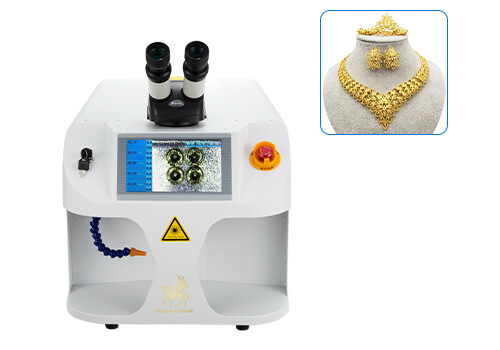
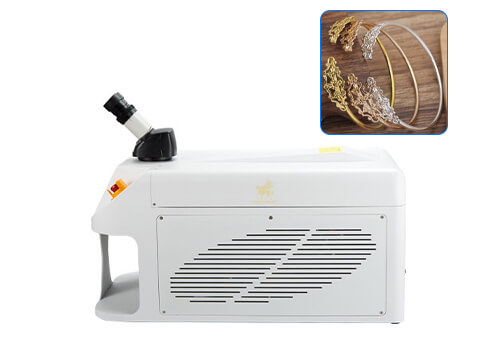
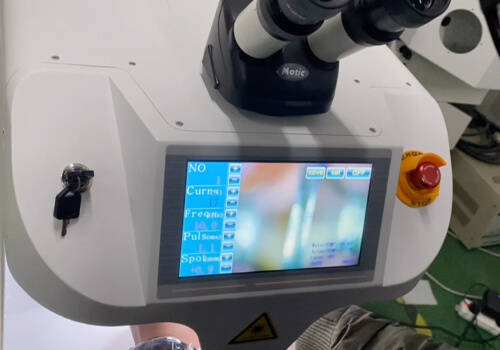
The SuperbMelt Gold Laser Welding Machine (Model SPB-150WB) is a professional Nd:YAG pulsed laser spot welder designed for jewelry repair, jewelry manufacturing, dental laboratories, and precision metal micro-welding.
Operating at 1064nm wavelength with up to 80J maximum pulse energy and 0.1–20ms adjustable pulse width, the machine welds gold (9K–24K), sterling silver, platinum, palladium, titanium, and base metals — without flame, without solder, and without the heat damage risk of conventional torch welding.
The built-in microscope and camera system provides precise weld point positioning. Water + air dual cooling supports extended continuous operation. Compact desktop footprint of 660×385×435mm, weighing 49kg.
ISO / CE / SGS certified. 2-year warranty. Trusted by jewelry workshops, repair centers, and dental labs in 50+ countries since 2009.
| Model | SPB-150WB |
| Wavelength | 1064nm |
| Max output power | 150W |
| Max pulse energy | 80J |
| Pump source | Single lamp |
| Pulse width | 0.1-20ms |
| Pulse frequency | ≤50Hz |
| Aiming and positioning | Microscope + camera system |
| Application | Welding and repairing various precious metal trinkets |
| Host power consumption | ≤5KW |
| Electricity demand | AC220V±5%/50Hz |
| Cooling system | Water cooling + air cooling |
| Dimension | 660x385x435mm |
| Weight | 49kg |
- Precision Micro-Welding — Spot Diameter 0.2–2.0mm Adjustable
Adjustable laser spot from 0.2mm to 2.0mm allows precise targeting of weld points on fine jewelry — prong tips, chain links, ring shanks, and micro-pave settings. The 1064nm Nd:YAG wavelength is optimized for precious metal absorption, ensuring efficient energy transfer with minimal surrounding heat spread. Weld results are invisible to the naked eye after light polishing. - No Heat Damage to Adjacent Gemstones
Unlike gas torch welding with a heat-affected zone (HAZ) of 5–10mm, the SuperbMelt laser concentrates energy into a HAZ as narrow as 0.1–0.5mm. Diamonds, rubies, sapphires, and other gemstones remain undamaged even when set 1–2mm from the weld point — no stone removal required for most repair and sizing operations. - Microscope + Camera System for Precise Positioning
The built-in stereo microscope and camera system allows operators to view and control the exact weld position before firing. Weld tiny metal parts with confidence — including 0.2mm wire diameter ultra-fine chains and micro-inlay claws that are invisible without magnification. Reduces operator error and weld rework rates to below 2%. - No Solder, No Flux, No Discoloration
Laser fusion welds base metal directly — no filler solder needed. Eliminates post-weld discoloration, flux residue cleanup, and the color mismatch problem of solder alloys on high-karat gold (18K, 22K) and platinum. The welded joint matches the base metal composition, requiring only a light wipe rather than full re-polishing. - Dual Water + Air Cooling — Extended Continuous Operation
The combined water cooling and air cooling system maintains optimal laser source temperature during extended production use. Supports continuous operation in high-output workshop environments without thermal shutdown interruptions. The imported ceramic condenser cavity has a rated service life of 8–10 years. - Compact Desktop Design — Workshop Ready in 30 Minutes
Machine dimensions: 660×385×435mm. Weight: 49kg. Connects to standard AC220V±5%/50Hz power supply. No special installation, ventilation, or foundation required. Operational within 30 minutes of delivery. Ideal for jewelry repair counters, workshop benches, and dental lab environments with limited floor space.
Why SuperbMelt Gold Laser Welding Machine


Any Question About SuperbMelt Gold Laser Welding Machine
Gold Laser Welding Machine: A Complete Guide for the Jewelry Industry
In the highly competitive jewelry industry, precision, efficiency, and quality are the cornerstones of success. Traditional gas welding has long been a staple, but in recent years, gold laser welding machines have emerged as a game-changer, reshaping how jewelers approach welding tasks. This guide delves into why the industry is embracing this technology, who stands to benefit most, answers the most pressing user questions, outlines key purchasing criteria, and explains why it’s a permanent upgrade from gas welding.
Why is the jewelry industry shifting toward laser welding?
The jewelry industry’s shift to laser welding is not a passing trend—it’s a strategic move driven by unmet needs in traditional processes and the unique advantages of laser technology. Here’s the breakdown of the core drivers:
1.1, Unavoidable flaws of traditional gas welding
- Excessive material loss: Precious metals like gold and platinum are highly malleable; gas welding’s broad heat-affected zone (HAZ) (typically 5-10mm) causes metal melting and splattering, leading to a loss rate of 5-8%. For a small workshop producing 100 meters of 18K gold chains monthly, this translates to a loss of 200-300 grams of gold annually—equivalent to thousands of dollars in wasted resources.
- Compromised jewelry aesthetics: Gas welding often leaves visible solder joints, discoloration, or blackening. Post-welding polishing requires removing additional metal to restore the finish, further increasing loss and labor costs. Delicate pieces like thin chains or micro-pendants are particularly prone to deformation under high heat.
- Limited precision for complex designs: As jewelry trends lean toward intricate patterns, micro-inlays, and ultra-fine structures (e.g., 0.3mm-thick chain links), gas welding’s lack of precision makes it impossible to target specific weld points without damaging surrounding details.
- Inconsistent quality: The quality of gas welding depends heavily on the jeweler’s skill—even experienced craftsmen struggle to maintain uniform weld strength and appearance across batches, leading to higher rework rates (often 10-15%).
1.2, Transformative advantages of laser welding
- Minimal heat impact & low loss: Laser energy is concentrated into a micro-sized beam (spot diameter 0.05-0.3mm), with a HAZ as narrow as 0.1-0.5mm. This precision eliminates metal splattering and melting of non-welded areas, reducing loss rates to 1-2%—a 75% reduction compared to gas welding.
- Invisible, aesthetically pleasing welds: Laser welding fuses metals without solder, creating seamless, tiny joints that require little to no post-polishing. The original texture and luster of the jewelry are preserved, enhancing the final product’s value and appeal (consumers are willing to pay 15-20% more for pieces with flawless finishes).
- Precision for micro-manufacturing: Laser beams can be focused on areas as small as 0.05mm, making them ideal for welding ultra-fine chains, micro-inlay claws, and delicate components like watch movements. This enables jewelers to take on complex, high-value projects that were previously unfeasible.
- Consistent quality & efficiency: Automated laser systems deliver uniform pulse energy and spot size, ensuring batch consistency with a rework rate below 2%. Welding speed is 3-5 times faster than gas welding—an 18K gold chain link that takes 30 seconds to weld with gas can be completed in 5-8 seconds with laser technology.
- Versatility across materials: Unlike gas welding, which requires different fluxes for different metals, laser welding works seamlessly with K-gold (14K, 18K, 22K), pure gold, silver, platinum, and even metal alloys. This flexibility simplifies production for workshops handling diverse materials.
1.3, Market demand for high-quality, customizable jewelry
- Higher quality standards: Brands and retailers increasingly require jewelry with invisible welds, no discoloration, and consistent strength—criteria that laser welding meets effortlessly.
- Customization capabilities: Laser welding’s precision allows for on-demand modifications (e.g., resizing rings, repairing family heirlooms) without damaging the original design, a key selling point in the personalized jewelry market.
- Compliance with international standards: Many global jewelry brands mandate low-loss, high-precision welding processes to meet sustainability and quality certifications (e.g., SGS, ISO 9001)—laser welding helps workshops qualify for these partnerships.
Who is a gold laser welding machine suitable for?
Gold laser welding machines are not one-size-fits-all—they excel in specific user scenarios where precision, low loss, and efficiency are critical. Here’s who stands to gain the most:
2.1, Small to medium jewelry workshops (1-10 employees)
- Core needs: Producing gold/silver chains, pendants, rings, and earrings; balancing quality with cost control; handling small-batch, diverse orders.
- Why it’s a fit: Compact laser welding machines (desktop or mini models) require only 1-2㎡ of space, ideal for workshops with limited floor area. The low loss rate (1-2%) directly boosts profit margins, while the easy-to-use interface means no need to hire specialized technicians (existing craftsmen can master it in 1-3 days). For example, a 5-person workshop producing 50kg of 18K gold jewelry annually can save over $10,000 in material costs with laser welding.
2.2, High-end jewelry brands & custom studios
- Core needs: Crafting luxury pieces (e.g., diamond-encrusted jewelry, platinum necklaces), maintaining brand reputation for flawless finishes, handling intricate custom designs.
- Why it’s a fit: Laser welding’s invisible joints and minimal heat impact preserve the integrity of precious gemstones (e.g., diamonds, sapphires) and delicate metalwork. High-end laser models offer microscopic observation systems and adjustable pulse parameters, enabling precise control for one-of-a-kind pieces. Luxury brands like Tiffany & Co. and Cartier have already adopted laser welding for their premium lines to ensure uncompromised quality.
2.3, Jewelry repair & restoration businesses
- Core needs: Repairing broken chains, resizing rings, fixing loose inlays, restoring antique jewelry; minimizing damage to existing designs.
- Why it’s a fit: Traditional gas welding often damages surrounding metal or gemstones during repairs. Laser welding’s targeted energy allows jewelers to weld specific points (e.g., a loose diamond claw) without affecting the rest of the piece. For antique jewelry, the minimal HAZ prevents historical details from warping or discoloring—critical for preserving value. Repair shops using laser welding report a 30% increase in customer satisfaction due to faster turnaround times and invisible repairs.
2.4, Large-scale jewelry manufacturers (mass production)
- Core needs: High-volume production of standardized pieces (e.g., chain necklaces, basic rings); ensuring consistent quality; maximizing efficiency.
- Why it’s a fit: Industrial-grade laser welding machines integrate with automated production lines, supporting 24/7 continuous operation with a welding speed of 1-3 meters per minute. The automated system reduces labor costs (one operator can manage 2-3 machines) and eliminates human error, ensuring uniform quality across millions of pieces annually. Large manufacturers like Pandora have adopted laser welding to scale production while maintaining precision.
Key questions users actually ask (based on real search intent)
- K-gold (14K/18K/22K): The alloy composition (gold + copper/silver/palladium) has a lower melting point (900-1050℃) than pure gold. Laser welding’s adjustable pulse energy (1-5J) easily melts the metal without causing segregation of alloy components, ensuring weld strength matching the base metal.
- Silver: Silver is highly reflective and prone to oxidation, but laser machines with fiber laser sources (wavelength 1064nm) overcome reflectivity issues. Combined with argon protection, welding silver produces clean, non-tarnished joints.
- Platinum: Platinum has a high melting point (1768℃) and high density. Laser welding machines with higher pulse energy (3-10J) and stable beam output can effectively fuse platinum, with weld strength exceeding 90% of the base metal—critical for durable platinum jewelry like engagement rings.
- Intuitive interfaces: Touchscreen displays with icon-based controls allow users to select preset modes (e.g., “18K gold chain welding,” “silver pendant repair”) without manual parameter adjustment.
- Visual guidance: Built-in microscopic observation systems (10x-40x magnification) or HD cameras display the weld point on a screen, enabling precise positioning even for beginners.
- Safety features: Automatic laser shutdown when the door is opened, overload protection, and anti-radiation goggles eliminate safety risks.
Five essential specifications to focus on when purchasing
- What it is: The ability to adjust and maintain a consistent laser spot size, directly determining welding precision and suitability for different jewelry types.
Key metrics to check:
- Minimum spot diameter: Should be ≤0.1mm (critical for ultra-fine chains and micro-inlays);
- Spot adjustability: Range of 0.05-0.3mm (to adapt to thick rings, thin chains, and everything in between);
- Spot stability: Variation ≤5% across 1000 consecutive pulses (ensures batch consistency).
- Why it matters: A machine with poor spot control may produce uneven welds, burn thin metal, or fail to penetrate thicker pieces. For example, welding a 0.2mm chain link with a 0.5mm spot will melt the entire link, while a 0.1mm spot targets only the joint.
- What it is: The consistency of laser energy delivered per pulse—stable energy ensures uniform weld strength and appearance.
Key metrics to check:
- Pulse energy range: 0.1-10J (covers all jewelry welding needs, from micro-repairs to thick metal joints);
- Energy stability: Variation ≤3% (measured over 500 pulses);
- Pulse duration adjustability: 0.1-10ms (shorter pulses for thin metals, longer pulses for thick metals).
- Why it matters: Unstable pulse energy leads to “weak welds” (insufficient energy) or “over-welds” (excess energy causing melting). For batch production, this results in inconsistent quality and higher rework rates. Reputable manufacturers provide energy stability test reports—always request this documentation before purchasing.
- What it is: The machine’s heat dissipation system and ability to run continuously, which affects usability and durability.
Key options & considerations:
- Air cooling: Suitable for low-power machines (≤300W) used for small-batch production (e.g., repair shops). Advantages: No water required, compact size, low maintenance. Limitation: Continuous operation time ≤2 hours (risk of overheating beyond that).
- Water cooling: Ideal for medium-to-high-power machines (300-600W) or workshops with high daily output (e.g., chain production lines). Advantages: Efficient heat dissipation, continuous operation time ≥8 hours. Limitation: Requires a water tank (5-10L) and regular water replacement (every 3-6 months) to prevent mineral buildup.
- Why it matters: A machine with inadequate cooling will frequently shut down, disrupting production. For a workshop producing 500 pieces daily, a water-cooled machine ensures uninterrupted workflow, while an air-cooled model may require 2-3 cooling breaks—reducing daily output by 20-30%.
- What it is: The visual aid for positioning the laser spot, critical for precise welding of small or complex jewelry.
Key features to evaluate:
- Magnification range: 10x-40x (10x for general welding, 40x for micro-inlays and ultra-fine details);
- Image clarity: HD display (resolution ≥1920×1080) with adjustable brightness and contrast (to adapt to different metal reflectivities);
- Focus adjustability: Easy-to-use knobs or electric focus to sharpen the weld point.
- Why it matters: Without a high-quality observation system, even the most precise laser beam is useless—jewelers cannot accurately target weld points, leading to damaged jewelry or failed welds. Machines with digital observation systems also allow for image capture, useful for quality control and client communication.
- What it is: Pre-programmed parameter combinations tailored to specific metals and jewelry types, designed to simplify operation for non-technical users.
Essential presets to look for:
- Metal-specific presets: 14K gold, 18K gold, 22K gold, 925 silver, platinum, palladium;
- Application-specific presets: Chain welding, ring resizing, pendant repair, micro-inlay, claw welding.
- Why it matters: Presets eliminate the need to manually adjust pulse energy, spot size, and welding time—saving time and reducing errors. For example, selecting the “18K gold ultra-fine chain” preset automatically sets the spot diameter to 0.1mm, pulse energy to 1J, and pulse duration to 0.5ms—optimized for that specific task. Machines without presets require users to experiment with parameters, increasing the learning curve and risk of mistakes.
How the machine is actually used in real working scenarios
5.1, Scenario 1: Welding 18K gold ultra-fine chains (0.3mm wire diameter)
- Equipment: Desktop fiber laser welding machine (300W), with 0.05-0.3mm spot adjustability, air cooling, and 40x microscopic observation.
- Preparation:
- Clean the chain links with alcohol to remove oil or dust (contaminants cause weak welds);
- Mount the chain on a precision fixture (adjustable to prevent movement during welding);
- Put on anti-radiation goggles and activate the argon gas (flow rate 8L/min).
- Operation steps:
- Turn on the machine, select the “18K gold ultra-fine chain” preset (automatically sets spot diameter 0.1mm, pulse energy 1J, pulse duration 0.3ms);
- Use the microscopic system to align the laser spot with the chain link joint (magnification 30x for clear visibility);
- Step on the foot pedal to trigger a single pulse—welding is completed in 0.3ms;
- Move the fixture to the next joint and repeat; for a 50cm chain (≈200 links), the entire process takes 15-20 minutes.
- Post-welding: Wipe the chain with a soft cloth to remove argon residue—no polishing needed, as the weld is invisible and the metal retains its luster.
5.2, Scenario 2: Repairing a loose diamond claw on a platinum ring
- Equipment: Medium-power laser welding machine (400W), water cooling, 10x-40x microscope, platinum preset.
- Preparation:
- Secure the ring in a ring holder with adjustable clamps (ensuring the loose claw is fully exposed);
- Clean the claw and diamond setting with a soft brush to remove debris;
- Confirm the diamond’s heat resistance (most diamonds are safe, but inform the supplier if using heat-sensitive gemstones like opals).
- Operation steps:
- Select the “platinum claw welding” preset (spot diameter 0.2mm, pulse energy 3J, pulse duration 1ms);
- Adjust the microscope to 20x magnification, focusing on the gap between the claw and the diamond;
- Trigger 2-3 consecutive pulses to fuse the claw to the setting—ensure the laser does not touch the diamond;
- Inspect the weld under magnification to confirm the claw is securely fastened without damaging the diamond or ring band.
- Post-welding: No polishing required—the weld is hidden under the claw, and the ring retains its original finish.
5.3, Scenario 3: Mass-producing 925 silver pendants (batch of 500)
Equipment: Industrial-grade laser welding machine (600W), water cooling, automated fixture, silver preset, continuous operation capability.
Preparation:
- Load the pendant components (base + decorative elements) into the automated fixture (capacity 50 pieces per batch);
- Calibrate the machine’s laser path to align with the weld points of all pendants;
- Fill the water tank and activate the cooling system; set argon flow rate to 10L/min.
Operation steps:
- Select the “925 silver pendant batch welding” preset (spot diameter 0.3mm, pulse energy 2J, welding speed 2 pieces per minute);
- Start the automated process—the machine moves the fixture sequentially, welding each pendant without manual intervention;
- After each batch (50 pieces, 25 minutes), unload the finished pendants and reload the fixture for the next batch;
- Conduct random quality checks (10 pieces per batch) to ensure weld strength and appearance consistency.
- Post-welding: A quick ultrasonic cleaning (5 minutes per batch) removes argon residue and dust, readying the pendants for plating or direct sale.
Why people who switch to laser welding almost never return to gas welding
6.1 Dramatically reduced material loss = higher profits
As mentioned earlier, laser welding cuts precious metal loss from 5-8% (gas welding) to 1-2%. For a medium workshop producing 100kg of 18K gold jewelry annually
(current 18K gold price ≈ $40/g), this translates to annual savings of 4–7kg of gold — worth $160,000–$280,000.
160,000-$280,000. These savings directly boost profit margins, enabling workshops to invest in new designs, marketing, or equipment upgrades. Gas welding’s high loss rate becomes financially unsustainable once jewelers experience the cost-efficiency of laser technology.
6.2 Superior quality = better customer satisfaction & brand reputation
6.4 Versatility = expanded business opportunities
- High-value niche markets: Micro-inlay jewelry, ultra-thin chains, and custom heirloom restorations—markets that gas welding cannot serve.
- Cross-material projects: Welding combinations like gold-plated silver or platinum accents on K-gold, which were previously challenging with gas welding.
- B2B partnerships: Meeting the quality requirements of luxury brands or large retailers, which often mandate laser welding for their supply chains. Once jewelers tap into these lucrative markets, gas welding’s limitations make it impossible to fulfill these orders.
6.5 Long-term cost-effectiveness = lower total ownership cost
While laser welding machines have a higher initial investment (typically
- Material savings: As calculated earlier, tens of thousands of dollars annually in precious metal savings.
- Labor savings: Reduced polishing time and lower skill requirements for operators.
- Maintenance costs: Laser machines have minimal moving parts and require only occasional cleaning of optical components (costing 100−300 annually). Gas welding requires regular replacement of torches, regulators, and solder (costing 1,000−2,000 annually).
 © Copyright 2008-2026 Superb Electromachinery Co., Limited