
Laser Gold Welding Machine
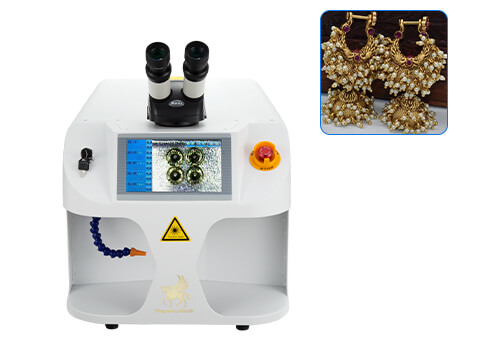
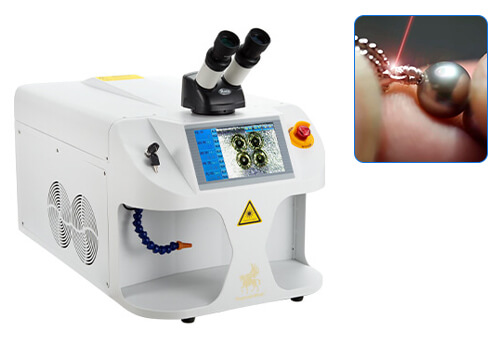
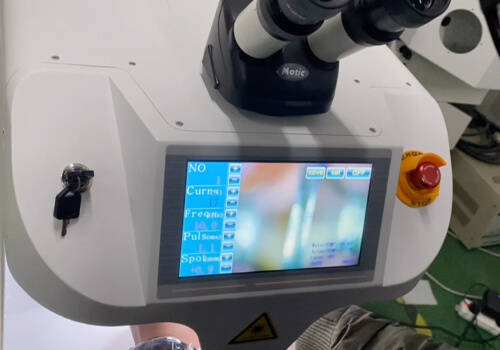
Superbmelt laser gold welding machine is used for welding and repairing metals. Superbmelt mini laser welding machine is suitable for welding base metals, karat gold, sterling silver, platinum, palladium, etc.
Superbmelt laser jewellery machine has a high level of welding accuracy and control. The welding process leaves no discolouration of welded spot or surrounding area. The microscope and camera system allows for proper aiming and positioning. The water cooling and air cooling units allow continuous welding. Superbmelt mini laser welding machine is applicable in the jewellery, medical, electronics industries, etc.
Contact Superbmelt today for the best jewellery laser welding machine.
| Model | SPB-150WB |
| Wavelength | 1064nm |
| Max output power | 150W |
| Max pulse energy | 80J |
| Pump source | Single lamp |
| Pulse width | 0.1-20ms |
| Pulse frequency | ≤50Hz |
| Aiming and positioning | Microscope + camera system |
| Application | Welding and repairing various precious metal trinkets |
| Host power consumption | ≤5KW |
| Electricity demand | AC220V±5%/50Hz |
| Cooling system | Water cooling + air cooling |
| Dimension | 660x385x435mm |
| Weight | 49kg |
- Superbmelt laser gold welding machine is suitable for a fast, clean and efficient metal welding process. The mini laser welding machine is used in industries such as jewellery, electronics, medical, automotive, etc.
- The 1064nm wavelength of the Superbmelt jewellery welding machine is suitable for welding karat gold, base metals, platinum, palladium, etc.
- The power required for welding metals with the jewellery laser machine is 150W and maximum pulse energy of 80J.
- Superbmelt jewellery laser welding machine offers you a high level of control and accuracy. The camera and microscope enable proper aiming and positioning of small parts.
- The gold jewellery laser welding machine provides a clean welding process compared to other methods of jewellery repair. The laser welding process leaves no discolouration on welded parts or surroundings.
- Superbmelt gold welding machine allows you to weld dissimilar materials and complex parts. This makes the laser welding machine the best choice for repairing artefacts and complex jewellery.
- The laser welding equipment requires ≤5KW, which make it impossible to discolour precious metals after welding.
- Superbmelt mini laser marking machine has a water and air cooling unit that prevents overheating. This allows you to weld continuously for long hours.
- Superbmelt gold jewellery laser welding machine is equipped with an imported ceramic condenser cavity that is resistant to corrosion and high temperature. The imported ceramic condenser has a lifespan of 8 to 10 years.
- Welding jewellery items with the Superbmelt jewellery welding machine makes repeated and consistent welding of jewellery. It is faster and more consistent than traditional soldering.
- Welding and repairing metal items with the laser gold welding machine allows you to weld the smallest parts, thereby preventing the loss of precious metals.
- Superbmelt laser welding machine for sale is compact in size, weighing only 49kg with a dimension of 660*385*435mm.

2 years warranty
The warranty for our machine is one year longer than the warranty provided by other factories.

Strong service team
We will give response within 24 hours against your problem by our professional engineer.

Why SuperbMelt Laser Gold Welding Machine


Any Question About SuperbMelt Laser Gold Welding Machine
Laser Gold Welding Machine Deep Guide: From Principles to Applications
Introduction: Why is the gold jewelry industry increasingly relying on laser welding?
In traditional jewelry manufacturing, welding typically relies on torch soldering. Although this method has a long history, it comes with clear limitations: it requires solder (which reduces metal purity and may cause color inconsistencies), it has a large heat-affected zone (wide heating can damage nearby gemstones or soften the metal through annealing), and it is difficult to work on extremely delicate components.
As consumers increasingly demand higher craftsmanship and as complex hollow designs become more popular, the jewelry industry’s need for precision and efficiency has reached its peak.
The introduction of laser welding technology has completely transformed the situation. It has become an essential tool in modern jewelry workshops for several reasons:
- Seamless welding:
No solder is required. The laser directly fuses the base metal, preserving the purity of precious metals (such as 18K gold or pure gold), and the weld does not oxidize or discolor. - Minimal heat impact:
Because the laser beam is highly concentrated, heat does not spread. This allows jewelers to perform repairs even on pieces set with diamonds, pearls, and heat-sensitive gemstones (such as emeralds or opals) without removing them. - Extreme precision:
With microscope-assisted operation and a laser spot as small as 0.1–2.0 mm, it can repair micro-defects that are barely visible to the naked eye.
Working Principles of the Laser Gold Welding Machine
What Is Laser Welding?
Laser welding uses a high-energy-density laser beam as the heat source. When the laser beam strikes the surface of gold, the light energy is absorbed and instantly converted into heat, causing localized melting and forming a small molten pool. Once the laser pulse stops, the metal rapidly cools and solidifies, creating a strong, reliable weld.
Why Is Laser Suitable for Gold?
Gold—especially high-purity gold—has extremely high reflectivity and thermal conductivity. Traditional welding heat sources struggle to penetrate its surface instantly.
The Nd:YAG laser (the most commonly used type for jewelry welding) emits a 1064 nm wavelength that is well absorbed by metals such as gold, silver, and copper.
With its high peak power, the laser can instantly “break through” gold’s reflective layer and form a keyhole effect, enabling deep penetration welding.
Why Core Parameters Matter
Operating a laser welding machine is essentially about balancing three key parameters:
1. Laser Energy (Energy/Voltage):
Determines the heat intensity of each pulse.
– Too low: weak welds
– Too high: metal explosion or spattering
2. Pulse Width:
Controls how long the heat is applied.
Narrow pulse: deeper penetration, suitable for structural spot welding
Wide pulse: heat spreads more evenly, resulting in smoother welds—ideal for surface repairs
3. Spot Size Adjustment:
Determines the weld area.
Smaller spot: higher energy density, stronger penetration
Larger spot: ideal for covering surface pores or imperfections
Which industries need a Laser Gold Welding Machine?
Beause Melting metal to mend or re-work your jewellery pieces will help you to expand on the style of jewellery you offer and the variation of jewellery pieces you supply. At Cooksongold, we supply all the metal melting equipment you need to successfully liquefy metal.
From hand torches to scorifiers, tongs and butane gas lighter fuel – we really are the one-stop shop for all your metal melting equipment. Browse our range of metal melting equipment and find our quality melting tools in a selection of shapes and sizes.
3.1, Jewelry manufacturing factories
Casting Porosity Repair
Process Background & Pain Points: Modern jewelry mass production primarily uses the lost-wax casting process. When molten metal is poured into plaster molds and solidifies during cooling, tiny surface pits often appear due to metal shrinkage or trapped gas bubbles in the mold. These pits, visible to the naked eye, are known in the industry as “porosity” or “air holes.”
Why Repair Is Necessary: If left untreated and polished directly, porosity appears as black spots, rendering the piece defective. Remelting the casting wastes significant labor, electricity, and metal. Traditional soldering often causes slight color differences with K-gold, and over time, the repair area may oxidize and darken, making the piece unsuitable for high-quality jewelry.
Laser Solution: A laser beam can directly “push” the surrounding metal to fill the holes or melt same-metal wire into the porosity. The repaired area fuses seamlessly with the base metal, leaving a dense, flawless, color-consistent repair without gold loss. This saves what would have been scrapped castings and greatly reduces production costs.
Batch Assembly & Joining
Pain Point: Complex jewelry composed of multiple components (like tennis bracelets with moving joints or two-tone rings) traditionally requires flux, torch welding, and acid cleaning to remove oxidation—labor-intensive, time-consuming, and environmentally polluting.
Laser Solution: Laser welding requires no flux or acid cleaning. Factories can use fixtures to perform fast spot welds—one weld per second—dramatically shortening assembly line time.
Integration into Automated Production Lines
For high-volume production of basic components (such as gold ear posts or necklace clasps), factories integrate fiber lasers into automated welding stations or robotic arms, enabling 24-hour unmanned precision welding while ensuring every weld maintains consistent strength.
3.2, Gold shops / jewelry stores (repair services)
Repair with Stones Set & Risk Control
Pain Point: This is the biggest nightmare for traditional jewelry repair. When a customer brings in a ring set with emeralds, pearls, coral, or opals—stones extremely sensitive to heat that can crack or discolor under high temperatures—for tightening loose prongs, conventional methods require removing the stones first, welding the prongs, and then resetting them. This process is time-consuming and carries a high risk of chipping or damaging the stones, often leading to costly compensation.
Laser Solution: The laser’s heat-affected zone is minimal (acting only on the spot), and heat does not transfer to the stones. Jewelers can weld under a microscope as close as 0.5mm from the stones. No stone removal is needed, and the repair is ready immediately. This eliminates the risk of stone damage and allows jewelers to accept high-difficulty repairs that traditional shops would avoid.
Seamless Resizing
Pain Point: Customers often need ring resizing after purchase. Traditional torch welding leaves a visible “black line” or shadow at the joint (due to low-melting solder and impurities), and the metal at the joint tends to be brittle.
Laser Solution: Laser welding fuses the parent metal itself, making the joint’s physical properties and color fully consistent with the rest of the ring. After polishing, there are no visible weld marks, achieving truly seamless resizing and enhancing customer satisfaction.
Chain Breaks & Hollow Jewelry Repair
Modern 5G gold or 3D hard gold jewelry often has hollow structures with extremely thin walls. Traditional torch welding melts and deforms these pieces easily. Only laser welding can precisely control energy to repair these ultra-thin hollow components without damaging their overall shape.
3.3, Independent designers / handmade jewelry studios
Ultra-Fine Structures & Filigree Work
Pain Point: Designers often create extremely fine gold wires (0.2mm–0.5mm) for openwork, lace, or filigree patterns. The flame from a traditional torch is too large and difficult to control, causing the delicate wires to melt or ball up instantly.
Laser Solution: Lasers can precisely control pulse energy and spot size, melting only the contact points between two fine wires without damaging the rest of the structure, making extremely intricate openwork designs possible.
Mixed Metals Joining
Pain Point: For aesthetic purposes, designers may want to combine 18K gold with 925 silver, or titanium with gold. Due to the significant differences in melting points and thermal expansion coefficients, traditional welding cannot achieve a strong bond.
Laser Solution: The high energy density of lasers enables metallurgical bonding between different metals, allowing the creation of unique two-tone or multi-material jewelry.
Antique Jewelry Restoration
Many antique pieces feature fragile enamel or precious historical patina. Laser welding is non-contact and extremely precise, repairing only the broken areas without damaging surrounding delicate enamel or the original aged finish.
3.4, Precious metal processing companies
Dental Prosthetics Fabrication: Repairs and bridge connections for dental alloys (such as gold-platinum alloys or cobalt-chromium alloys) require extremely high biocompatibility. The oral cavity cannot contain harmful heavy metal solder components. Laser welding uses the base material itself without adding solder, perfectly meeting medical and hygiene standards.
High-End Watch Repair: Used for fixing broken gold watch bands or dents on watch cases (by building up gold wire to fill depressions), restoring the watch’s original value.
What power do you need? (Fiber vs. Pulse Laser)
When purchasing, the most commonly discussed parameters are the power rating (60W, 100W, 200W…) and the type of laser source.
4.1, Differences between 150W, 200W, and 300W
Here, the power usually refers to the average power. For most gold (18K, 24K) and platinum jewelry:
60W – 100W: Entry-level / light use. Sufficient for most gold chain welding, fine ring resizing, and porosity repair. For a pure gold store, this power is adequate.
150W – 200W: Gold standard / all-rounder (most recommended).
Why recommend 200W? Although welding gold alone doesn’t require such high power, if you need to weld silver, high power is necessary. Silver has extremely high reflectivity (much harder to weld than gold) and conducts heat very quickly. Low-power machines attempting to weld silver are like “pouring water on a mirror”—it simply won’t melt. A 200W machine provides enough peak power to overcome silver’s reflectivity.
300W+: Industrial / heavy-duty processing. Used for very thick pieces, continuous high-intensity factory work, or large-scale thick silver jewelry production.
4.2, Pulse laser vs. continuous laser
Pulsed Nd:YAG (Lamp-Pumped):
This is currently the standard configuration in the jewelry industry (box-type machine with a microscope).
Advantages: Very high single-pulse energy, ideal for precise spot welding, prong repairs, with the most accurate heat control.
Disadvantages: Requires periodic replacement of the flash lamp (consumable).
Continuous Wave Fiber Laser (CW Fiber):
Commonly used in handheld welders or factory automation lines.
Advantages: Maintenance-free, long lifespan, suitable for long seam welding (e.g., fixing bracelet joints).
Limitations: For extremely fine repairs (such as 0.3mm prongs), the heat accumulation of continuous lasers is harder to control, which can lead to overheating.
How to choose the right Laser Gold Welding Machine?
Within your budget, focus on the following key indicators:
Microscope Quality:
You’ll be looking through it all day. A Leica or equivalent-grade microscope is preferred, as it effectively protects your eyesight and provides clear depth of field and accurate color reproduction. Low-quality microscopes can cause dizziness, fatigue, and poor focus.
Cooling System (Water Chiller):
Choose a machine with a built-in powerful water cooling system (with compressor cooling). Lasers are extremely sensitive to temperature—poor heat dissipation can lead to energy decay during prolonged work (the first pulse is strong, the tenth pulse weak, causing inconsistent welds).
Beam Quality & Beam Expander System:
A high-quality machine can maintain uniform energy distribution when adjusting the spot size (flat-top or near-Gaussian distribution), avoiding “center burns through while edges remain unmelted.”
Working Chamber Space:
If you often repair bracelets, large necklaces, or decorative items, you need an open or spacious chamber (with a well-placed joystick). Otherwise, reaching inside becomes awkward and inefficient.
What can a laser gold welding machine weld?
Although it’s called a “Gold Welding Machine,” it’s actually an all-rounder for precious metals.
Gold:
18K/14K: Easiest to weld, flows well, perfect results.
24K Pure Gold: Very soft and highly reflective. Lower voltage and longer pulse width are needed to prevent piercing or collapse.
Rose Gold: High copper content, prone to oxidation and darkening when cooling. Argon shielding gas is required to keep welds bright.
Silver:
The most difficult precious metal to weld. Requires “high voltage, short pulse width, defocusing” techniques and high-power machines (200W+ recommended).
Platinum & Palladium:
Excellent welding performance, melts without flowing and sets quickly. Laser is the best tool for platinum, fully solving the traditional difficulty of welding platinum.
Titanium & Stainless Steel:
Fully compatible, commonly used for jewelry clasps, medical-grade earrings, and fashion jewelry.
Mixed Metals:
Laser can weld gold to silver, gold to steel, enabling special bi-metal or multi-material designs.
Summary Recommendation:
For a standard jewelry repair shop or custom studio, a 200W desktop pulsed Nd:YAG laser spot welder (equipped with a high-quality microscope and optional external CCD camera for client demonstration) offers the best ROI. It can handle factory-level batch casting porosity repair, fine in-store resizing, stone-in repairs, and even silver welding.
FAQ Guide of Laser Gold Welding Machine
- 1. What is Laser Gold Welding Machine?
- 2. How is jewelry welded nowadays?
- 3. What are the cases in which jewelry should be welded?
- 4. How to produce gold jewelry to be welded?
- 5. What are the advantages of laser welding methods for jewelry compared with other procedures?
- 6. Why is a laser welder required for welding jewelry?
- 7. Where is the laser welding machine used?
- 8. Can laser beam welding be used in mini welding machines?
- 9. Does welding consume precious metals?
- 10. How to process the jewelry laser welding machine?
- 11. Mention the core parts of the jewelry laser welding machine and also mention how to maintain them?
- 12. Are other metals required to repair jewelry?
- 13. Which types of lasers can be used in jewelry repair?
- 14. How strong does laser welding repair the jewelry?
- 15. What is the principle of the gold laser welding machine?
- 16. Can you solder jewelry with a laser?
- 17. Why is a laser welding machine the best choice for jewelry welding?
1. What is Laser Gold Welding Machine
Laser welding is a contactless process where different metal parts are assembled mainly by a laser beam. This type of welding is appropriate for applications that use high-speed welding and low distortion. The high-level automation and speed make laser welding a very widely used method in many industrial sectors. The laser jewelry welding machine can weld stainless steel, copper, Kovar, Inconel, silver, etc.
The different types of laser welding machines are:
- Special Laser welding machine
- Sensor Laser welding machine
- Jewellery Spot welding machine
- Automatic Laser welding machine
Laser gold welding machines are used to weld and repair different types of metal pieces together. The laser gold welding machine is appropriate for welding base metals, karat gold, sterling silver, platinum, and palladium. The gold welding machine price is high. Nonetheless, the gold welding machine price is reasonable too.
The wavelength of the laser gold welding machine makes it fitting for welding the tiniest parts efficiently. The laser gold welding machine performs a speedy and clean welding process. A laser gold welding machine does not comprise complex procedures, is very easy to use, and has a long service life.
2. How is jewelry welded nowadays?
For welding metal, there are a few changes in welding depending on the metal, but other than that, the same steps are followed for welding metal.
- Set up a safe workplace:Firstly, the workplace needs to be set up in a safe and well-ventilated area. A large ceramic tile, a heat resistance pad or fire brick, and an overhead lamp will be required for welding. On top of the tile, put the fire brick.
Other than the items mentioned above, a pair of copper tongs, a small paintbrush, a pickle pot, and solder and flux are also required.
- Welding tool preparation: After safely setting the workplace up, make sure the equipment needed for welding is all cleaned. Some of the tools required are a portable laser welding machine, a pair of tongs, hydraulic press, hammers, etc.
- Design the jewelry piece:After inspecting all the equipment and tools, design the jewelry piece on a silver or copper sheet. For different and impressive patterns and images, hammers and rolling mills can also be used. After creating, cut the design out of the copper or silver sheet.
- Shape the sheets according to the design:After cutting the design out of the sheet, shape the sheet material according to the invention using the hydraulic press machine.
- Combine the parts:Lastly, using the jewelry welding laser machine, combine all the elements according to the design. The annealing temperature of copper is higher compared to silver so try to heat the copper first. Drop the welded pieces into a jar of water using the tweezers. If more welding is required, follow the same steps.
3. What are the cases in which jewelry should be welded?
The jewelry laser welder is one of the most advanced developments in the jewelry industry. One can buy high-quality laser welder jewelry for sale and can use that to weld jewelry. They can use it to deal with porosity issues in a finished product. Using the jewelry laser welder, one can correct the porosity level in the jewelry piece by combining different types of metal and using it in the particular porous area. Since it gives accurate precision, the other parts of the jewelry piece won’t get affected.
This laser jewelry welding machine provides the exact amount of heat that helps repair and weld delicate jewelry pieces and helps in intricate designing.
One can also use the recasting process for different metals. This jewelry laser welding machine helps an individual to save money as well as hours of hard work.
4. How to produce gold jewelry to be welded?
To produce gold jewelry for welding, follow the steps mentioned below:
- Clean the metal:Make sure that the metal is cleaned and is grease-free before soldering. To ensure that, dip the metal in a pickle solution, and by using tweezers, clean it thoroughly.
- Accurate fitting:Place the metal you will be welding or soldering and hold it together with tweezers to ensure that the metal you want to solder fits perfectly and creates a tight and perfect joint.
- Add flux:Coat the soldering areas with flux to prevent discoloration and to remove impurities. Now gently heat the flux using the hand torch until the flux bubbles off.
- Add gold solder:Cut a small piece of gold solder and add it to the join. Again, using the hand torch slowly heats the gold and not the solder. After melting, when the solder flows into the metal, stop giving the heat.
- Please put it in the pickling solution:After stopping the heat, cool it by placing it in a jar of water. After cooling it, dip it into the pickling solution using copper tongs, and then after removal, polish it off once, and the piece is ready.
5. What are the advantages of laser welding methods for jewelry compared with other procedures?
The jewelry laser welder method is preferred more than traditional welding methods because it has more advantages than other methods.
- Less heat:The jewelry laser welder method produces less heat than other ways since the beam of the jewelry laser welder is much more focused. As a result, the metallurgical structure is gets affected more diminutive, and the quality of the weld is much higher and better than the quality of traditional forms of welding.
- Accurate and high-quality finish:Jewelry laser welder is a much more precise manufacturing process, and welds can be as small as one-hundredth of a millimeter. Tiny pulses of heat create the weld, leading to an accurate and better quality finish, which provides a better ratio between depth and width.
- Welds greater variety of metals:An additional definite advantage of jewelry laser welders is that people can also weld a wide variety of metals such as high strength stainless steel, aluminum, titanium, carbon steel, and such precious metals such as gold or silver. The manufacturing method is excellent for delicate components, and it can be used in areas with limited access.
The benefits of jewelry laser welders for modern techniques over other welders are many. Laser welding overall has a much broader application. Also, it holds the potential to weld a more significant number of metals to a much better quality which is essential where precision engineering is needed.
6. Why is a laser welder required for welding jewelry?
The causes for using a laser welder to weld jewelry are mentioned below:
- Easy to carry and quick repair:The jewelry laser welding machine is a relatively small and mobile device which makes it easier to use and maintain. The jewelry laser welding machine turns repairs that were once tedious and impossible into a rapid and seamless repair.
- Pinpoint accuracy:The jewelry laser welding machine has been introduced very recently, but it has created a lot of innovation in the jewelry industry since then. It produces a tiny beam of light that allows the jewelers to weld with pinpoint accuracy.
- Less invasive and eliminates steps:The jewelry laser welding machine is much cleaner and less invasive, and it also removes a lot of effort in jewelry repairs. Solder material and flux are also eliminated when your jewelry repair is done with a laser welder.
Hence, using a jewelry laser welder is very beneficial.
7. Where is the laser welding machine used?
As mentioned above, the joining of different materials using a laser beam is known as laser welding. Since it has many benefits and is easier to use, it has several uses in various industries. Laser welding is well-known due to its pinpoint accuracy, high-quality finish, and low distortion level. Using the jewelry laser welding machine, one can design and easily shape unique jewelry based on their customers’ likes.
8. Can laser beam welding be used in mini welding machines?
Yes. Mini welding machines do use laser beam welding. Large and tiny pieces of metal can be joined easily utilizing this machine. Thermoplastic items are also quickly joined utilizing this machine. Since the devices are designed to produce concentrated heat sources, the finished products are narrow and deeply welded. The outputs or the finished products are well designed and welded.
9. Does welding consume precious metals?
Welders engaged in this field can use the mini welding machine for welding precious metals since it does not consume precious metals. However, it is seen that if the correct configuration is not maintained, then it can affect the output. Whereas, if the design is carried correctly, then the work produced by the mini welding machine will be much higher. People involved in the welding sector can use mini welding machines to make unique jewelry from precious metals.
10. How to process the jewelry laser welding machine?
The jewelry laser welding machine uses a very highly concentrated beam of light on a very minute spot. The zone under the laser beam becomes highly energetic by absorbing the light.
Based on the power of the laser beams used, the materials of the electrons in the zone start melting as the result of the electrons getting excited and the atoms breaking bonds with each other.
Since the materials start melting at their seams, they fuse into a joint. It is truly astonishing how powerful light can be to melt metals within seconds. The jewelry laser welding machine uses numerous parts that direct and amplify the laser to achieve such powerful laser beams.
11. Mention the core parts of the jewelry laser welding machine and also mention how to maintain them?
The jewelry laser welding machines come with different parts to offer better operation, just like other electronic devices. The durability of the jewelry laser welding machine will determine the skills of the machine. One should also check the viability and efficiency of the parts of the jewelry laser welder since they also choose the proficiency of the device.
The core parts of the jewelry laser welding machine are as following:
- Lasers:The three most common types of lasers used in a laser welding machine are mentioned below;
- Gas lasers:It is a laser that produces coherent light with the help of electrical currents. The electrical currents are discharged using a gas.
- Solid-state lasers:They use solid as a gain medium instead of using liquid. The semiconductor-based lasers, although being in a solid state, are considered different from solid-state lasers.
- Fiber lasers:They use an optical fiber doped with rare earth elements, such as ytterbium, dysprosium, etc., as the gain medium. It provides a very high level of beam quality which gives accurate precision and high-power density.
- Optical fibers:They are transparent and flexible fibers made using silica or plastic. It is slightly thicker than an average human hair. It keeps light in the core by the phenomenon of total internal reflection and causes the fiber to behave as a waveguide.
- Collimator lens:It is a device that narrows a beam of waves or particles. Here, the narrowing can either mean that the spatial cross-section of the beam became smaller or the directions of motion became more aligned.
- Weld joints:For laser welds, three main joints are capable. They are:
- Butt Weld:It is the most commonly used technique. It can either be automated or, with the help of steel pieces, done by hand.
- Fillet Lap Weld:It refers to joining two pieces of metal together when they are perpendicular or at a specific angle.
- Overlap Weld:It is the bulge of weld metal beyond the roof.
- Processing gas:Process gas, also known as cutting gas, is the flow of gas that is directed towards the location of the weld to prevent the surface of the weld from coming in contact with oxygen, hydrogen, nitrogen, or any atmospheric gas.
People should check the pulse width and the power before buying the jewelry laser welding machine. It should be handled carefully and adequately, and all the parts should be maintained and checked regularly to avoid damage. Even before ordering, You should review the core parts. Watt is used to measuring the power unit, and the density will influence the weld penetration.
12. Are other metals required to repair jewelry?
The most common jewelry repairs are:
- Ring resizing
- Gold plating
- Stone setting
- Soldering
- Chain and clasp repair
According to experts, other metals are not required to repair jewelry. A laser is typically used to polish different types of metals or to join different kinds of metals. Therefore, various metals are not required under any of these processes, and only using a laser to complete the procedures mentioned above is enough.
13. Which types of lasers can be used in jewelry repair?
Different types of lasers find their usage in the jewelry industry. Some of the most commonly used lasers are:
- Solid-state lasers
- Gas lasers
- Diode lasers
- Fiber lasers
Laser welders are used for repairing jewelry. By emitting a sharp and focused beam of light, lasers help jewelers to accomplish tasks that were either too time-consuming or impossible. The laser’s concentrated heat also helps to repair delicate and fragile parts without risking further damage.
With the help of laser welders, one can work very close to heat-sensitive stones and still manage not to destroy them. Repairs that once required numerous steps, setting stones, disassembling parts can now be completed in a single effort.
The time saved produces higher production and more profit.
14. How strong does laser welding repair the jewelry?
Laser welding is a high speed and extremely fast. If we compare to Tungsten Inert Gas (TIG) welding, then the rate of laser welding is much higher, and if compared to Metal Inert Gas (MIG) welding, then laser welding is 3 to 5 times faster in different applications.
Other than that, during welding, fillers made up of different metals can be used to increase the strength of the jewelry based on the requirements. A gold laser welding machine is always trustworthy when looking for a durable joint. Nonetheless, You must check the jewelry laser welding machine price before buying the device.
15. What is the principle of the gold laser welding machine?
The principle of the gold laser welding machine is to amplify light. Normal light can not be used as laser light since the radiant energy from normal light is incoherent and is distorted over a wide spectral range.
Therefore, the laser has to depend upon radiation stimulated emission or the emission induced by electromagnetic energy absorption or by photons for its operation. While the absorption of energy occurs, the electrons present in the atoms increase and expand their orbits. As a result of their orbit expansion, the particles go into a state of excitement.
This state is short-lived, and it immediately drops back to a metastable state. While settling back, the heat energy of the atom is lost, but the photon energy is still present. As soon as the particle falls spontaneously, the photon energy is released in the form of light.
16. Can you solder jewelry with a laser?
Yes. Laser soldering is a process in which a very accurate and precise laser beam provides restricted and controlled heating of the solder alloy, which leads to a very fast and non-destructive electrical joint.
This process uses a controlled beam of laser for the transmission of energy to a soldering location where the energy which is absorbed gets heated by the solder until the melting temperature is reached, which leads to contact soldering, and it also eliminates complete contact of mechanics.
In the production of electronic assemblies and the soldering of electronic components to circuit boards, laser soldering has been used.
The laser soldering system comprises focusing optics, illuminator, fiber optic module, laser generator, X-Y positioning stage, along with the design of servo control and the motion module.
The Laser soldering machine has a lot of advantages, like:
- It is wholly contactless and the energy applied is locally limited.
- It produces very low thermal stress.
- The energy input is both temporally and spatially controlled.
- It has low maintenance.
- It is easily adaptable and is also very flexible.
17. Why is a laser welding machine the best choice for jewelry welding?
The jewelry laser welding machine is the best choice for jewelry welding for the following reasons:
- Minimal deformation:The deformation and shrinkage in the material are minimal due to the laser welding process.
- It is one-sided:The jewellery spot welding machine requires accessibility on both sides of the material, whereas the jewelry laser welding machine requires accessibility on only one side.
- Less scrap production:Since the jewelry laser welder produces highly accurate precision, it also has less scrap.
- Accurate precision:Compared to Tungsten Inert Gas (TIG) welding and Metal Inert Gas (MIG) welding, jewelry laser welding produces a much higher and more accurate precision. The precision one can get from laser welding is the best. It will be hard to find accuracy as precise as laser welding anywhere else.
- Computer input:Laser welding does not require the skills of conventional welding since it works on a computer and produces input and output with the help of a computer.
- Heated area:The welded area stays heated for quite some time, and the spread of heat is also standard. But in laser welding, the heat does not spread to the remaining material and can be instantly handled just after the job is finished.
- Strength of weld:The weld strength is even better than Tungsten Inert Gas (TIG) and Metal Inert Gas (MIG) since the weld is narrower and thus provides an excellent depth width ratio.
- Less time required:The time needed for jewelry laser welding reduces if you use laser welding.
Even though there are some disadvantages, like high initial cost, the jewelry laser welding machine price is high. The maintenance costs are high, and highly skilled labor is required; the laser welding machine is a much better option.
Thus, laser welding is a very safe and contactless process, and it is very much in trend nowadays. Thousands of industries prefer the laser welding method above all due to its accuracy, depth width ratio, and faster outputs.
 © Copyright 2008-2026 Superb Electromachinery Co., Limited