
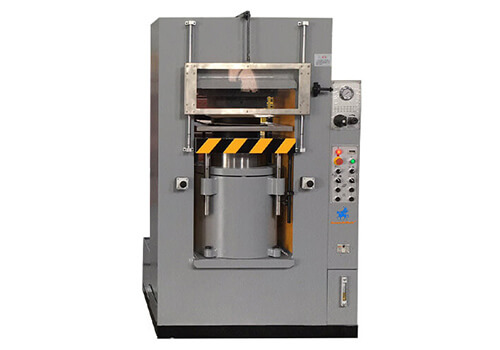
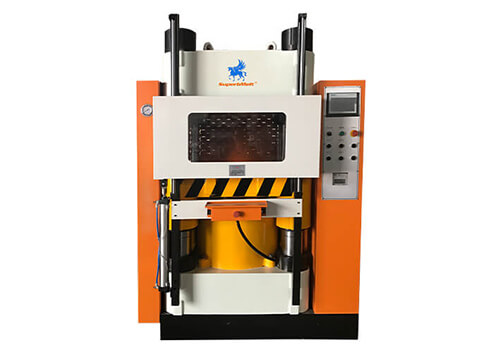

| Item | Unit | SPB-500TP | SPB-500TS | |
| Photo | 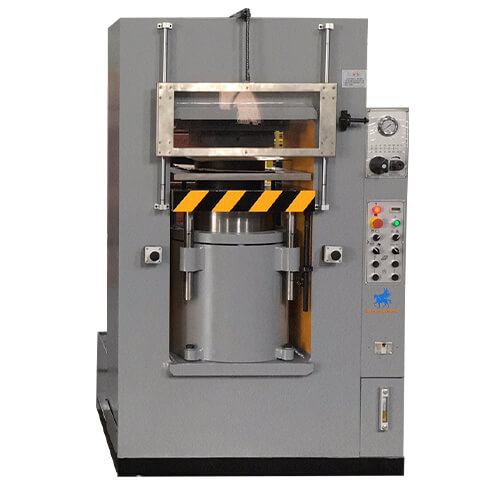 | 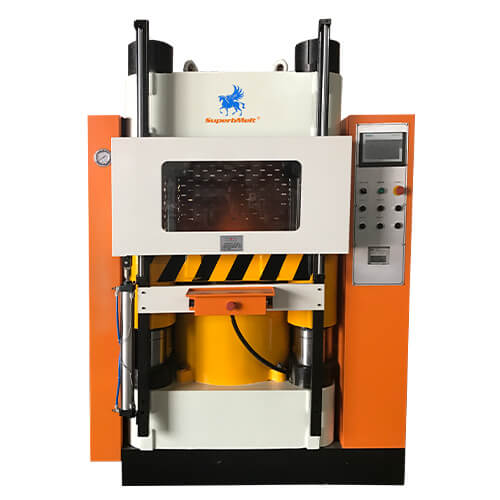 | ||
| Rated capacity | Ton | 500 | 500 | |
| Max. system pressure | Mpa | 25 | 25 | |
| Max. stroke of working table | mm | 150 | 150 | |
| Open height | mm | 450 | 450 | |
| Height of movable working table | mm | 1185 | 850 | |
| Upward speed of movable working table | mm/s | 80 | 215 | |
| Returning speed of movable table | mm | 80 | 200 | |
| Movable working table size | L-R | mm | 710 | 600 |
| F-B | mm | 640 | 560 | |
| Overall dimension | L-R | mm | 1440 | 1480 |
| F-B | mm | 1370 | 1520 | |
| H | mm | 2080 | 2300 | |
| Motor power | kw | 15 | 23 | |
| Weight (Approx.) | kg | 5500 | 6700 | |
- Superbmelt 500 ton hydraulic press has the capacity of pressing about 500 tons of metals. This capacity is suitable for medium and large scale stamping requirements.
- In deep drawing applications, Superbmelt machine press is applicable in aluminium cans, steel utensils, LPG cylinders, fire extinguishers, etc.
- The hydraulic press helps you to save on operating costs through the reduced energy use and the number of manual labour required. A single worker can operate the hydraulic press irrespective of the production capacity.
- The innovative technology embedded in the Superbmelt 500 ton hydraulic press makes it highly automated. Also, the use and control of the stamping press are easy with the PLC control unit. The unit makes pressing more convenient.
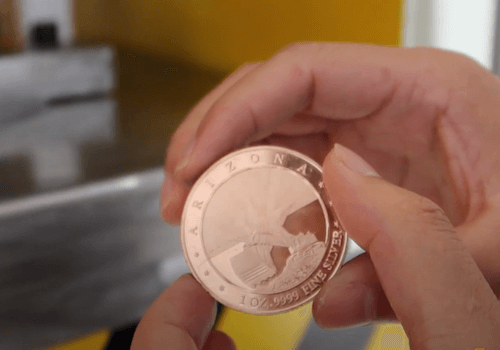
- The servo motor driven system controls the speed and pressure of pressing precious metal coins. The servo motor driven system also ensures the stability of the machine and controls the noise of the machine.
- The hydraulic stamping machine requires 15-23kw of power. With this pressing machine, you save up to 40% to 60% of energy. Energy-saving and speed of stamping help to reduce production costs while maintaining a high level of efficiency.
- Superbmelt hydraulic press machine is the complete opposite of the CNC pressing machine. This is because of the automation, hydraulic system, speed and accuracy of stamping.
- Superbmelt 500 ton is powerful enough to process high-strength materials. As a result of this, heavy duty machines are a necessary component in industries such as automotive, aviation, military, etc.


In precious-metal manufacturing, press tonnage is critical to final gold ingot quality and production efficiency. Pure gold bars must achieve a density around 19.32 g/cm³. If a press is too weak, bars can have internal voids or cracks, dropping density and rendering them unmarketable. Using the correct press strength ensures dense, defect-free bars; the wrong choice leads to scrap, hidden costs, and production delays. In this guide, we explain why tonnage matters and how 315‑ton vs. 500‑ton presses compare, helping you match press capacity to your product and throughput needs.

Why Tonnage Matters
Gold’s exceptional density (≈19.32 g/cm³bullionbypost.co.uk) means even minor gaps in a bar are unacceptable. Industry standards require near-solid bars; any deviation in weight or volume can dramatically affect value. As one bullion expert notes, “Even a tiny deviation in weight can shift a bar’s total price”pacificpreciousmetals.com. Low-density bars also warp under rolling or forging, causing cracks. Any internal void or crack is a fatal defect – for example, the London Bullion Market Association warns that shrinkage cracks make a bar “unacceptable” for deliverylbma.org.uk.
Key risks of insufficient press tonnage include:
Low Density / Void Formation: Inadequate pressure leaves micro-porosity. Bars may weigh less than their volume implies (e.g. a “1 kg” bar might only weigh 950 g), eroding material valuepacificpreciousmetals.com. Voids also undermine bar strength, risking failure in later processing.
Cracking: Uneven internal stress causes visible or hidden fractures. These bars must be remelted; LBMA guidelines specifically cite such cracks as disqualifyinglbma.org.uk.
Springback and Deformation: Metals rebound elastically after forming. A weak press cannot fully overcome this springback, so edges sag and shapes distort. For instance, a rectangular ingot might cave in along corners or warp if pressure is insufficient.
High Rework/Scrap Rates: Defective bars require remelting and re-pressing, incurring extra time, energy, and labor. Over years, even a 5% rework rate in a high-volume line can cost tens of thousands of dollars. (For example, reworking 5% of 1001 kg bars/day over 3 years adds ~5.5 tonnes of reprocessed gold – a significant hidden expense.)
Meeting quality standards (e.g. LBMA or COMEX) means density and precision are non-negotiablepacificpreciousmetals.com. Therefore, selecting the right press tonnage is the first step to consistent, compliant production.
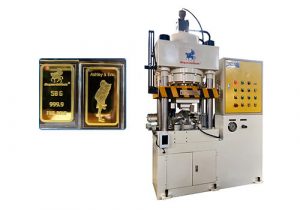
315T vs 500T: Core Differences
Both 315‑ton and 500‑ton hydraulic presses are common in ingot production, but they serve different niches. The differences go beyond the “500” vs “315” label; they affect forming power, compatible bar sizes, final bar quality, and production stability. Key contrasts include:
Actual Forming Pressure: The nominal tonnage is not the full story. Due to fluid losses and machine limits, a 315T press delivers roughly 85–90% of that pressure (≈270–284 tons) under ideal conditions. A 500T press can similarly deliver ~425–450 tons of actual force. In practice, this means:
315T press can fully compact small, high-purity gold charges (100–500 g bars, or very thin 1 kg bars). But it struggles on thick or heavy loads: a 1 kg bar thicker than ~20 mm often won’t reach full density because the pressure over the larger area is insufficient.
500T press has ample reserve. It can easily handle 1–5 kg bars (up to ~30–40 mm thick) in a single stroke. Even larger bars (5–10 kg, ~50 mm thick) or lower-purity scrap charges can be fully densified because of the extra force.
Compatible Bar Sizes: In practical terms:
Small ingots (0.1–0.5 kg): Both presses handle these comfortably; 500T simply has extra capacity.
Standard bars (~1 kg): 315T works only if the bar is thin (~≤20 mm). Thicker 1 kg bars will come out under-dense or need multiple presses. A 500T press can make a thick 1 kg bar (30–40 mm thick) in one go, with stable density.
Medium bars (2–5 kg): 315T is marginal – it may require two-stage pressing and often yields a lower first-pass density. 500T easily forms these bars at full density in one cycle.
Large bars (>5 kg): 315T effectively cannot produce dense large bars – expect cracks or incomplete compaction. 500T can form very large ingots (up to ~50 mm thick) for industrial applications.
Compression Quality and Appearance: The higher-pressure 500T press consistently achieves densities at or above 19.28–19.32 g/cm³ (meeting the 19.32 standard) for all bar sizes. A 315T press often reaches ~19.2–19.25 in its optimal small-bar cases, but will fall short (e.g. ~19.0–19.1) on heavier loads. 500T bars tend to be fully solid with no voids. Edge quality is also better: low-tonnage presses often leave edges “caved-in” or “rounded” (requiring post-press grinding), whereas bars pressed with sufficient force have crisp, flat edges and smooth surfaces ready for delivery.
Production Stability and Durability: Continuous operation is critical in industry. A 315T press under high load heats up faster and shows greater pressure fluctuation (often ±5% in output). Running it beyond its comfort zone accelerates wear: seals and cylinders need replacement more often, and minor pressure spikes can appear. By contrast, a well-built 500T press (usually with a rigid cast frame and dual hydraulic pumps) maintains very stable output (fluctuations around ±2%) even in high-speed production. In normal use (e.g. pressing 100 + bars/day), a 500T machine operates well below its maximum capacity (often only 60–70% loaded) – this means less wear and longer service life. Industry experts recommend keeping a safety margin (typically 15–20% above required force) to avoid stressharsle.com, which the 500T inherently provides.
In summary: 315T is suited to small-scale, light-load pressing, whereas 500T provides the extra “headroom” for larger bars, tougher materials, and nonstop production.
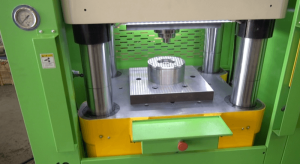
Matching Press to Production Needs
Choosing between 315T and 500T depends on your product mix and throughput. Here are general guidelines:
Small-batch or Pilot Production: If you are producing few bars per day (e.g. ≤50/day) and they are mostly small (≤500 g) or thin 1 kg bars, a 315T press may suffice. Its advantages are lower cost, smaller footprint, and simplicity (often about US$21k–35k new). It consumes less power idle and can be a good fit for startups or trial lines. However, remember its limits: if you later expand to larger bars, you will need new equipment.
Large-scale Production (1–5 kg Bars): For daily outputs ≥100 bars or when producing standard 1–5 kg bars (especially if using recycled/less-pure gold), a 500T press is strongly recommended. It ensures you meet quality standards without rework, and it can handle spikes in demand or thicker bars with no extra delay. The US$42k–63k initial investment pays off through higher first-pass yield, faster cycle times, and less downtime. It’s the norm for industrial and financial-grade ingot production.
Expansion Planning: Some companies wonder if they should “go big” from day one. If you have firm plans for volume growth or large-bar orders in 1–2 years (e.g. stable contracts, entry into high-end markets, or significant recycling operations), it’s often wiser to buy the 500T outright. This avoids a future retrofit/upgrade (and the associated downtime and extra cost). On the other hand, if your future is uncertain and budgets are tight, you can start with 315T but plan for upgrade. At minimum, ensure your facility (floor space, power, foundations) can accommodate a 500T later.

Tonnage by Daily Throughput: As a rule of thumb:
≤50 bars/day (100–500 g bars): 315T is usually enough.
50–100 bars/day (0.5–1 kg bars): Use 315T if most are <500g; use 500T if >50% are 1 kg thick bars (for efficiency and yield).
100–200 bars/day (1–2 kg bars): 500T recommended. A 315T will struggle to maintain consistency at this pace.
>200 bars/day (>2 kg bars): 500T is essentially the only choice for stable production and meeting quality.
Always consider both product (bar size, thickness, material purity) and production rate. Undersizing your press creates bottlenecks and quality issues; oversizing it (buying 500T for only tiny bars) wastes capital and increases operating costsharsle.com. The goal is the right tool for your current needs and some headroom for the future.
Cost and Value Over Time
While initial purchase price is important, don’t lose sight of total cost of ownership (TCO) and value creation:
Purchase Cost: A new 315T gold-pressing machine typically costs on the order of ¥150k–250k (~US$21k–35k) depending on features (manual vs. automated, control precision, etc.). A 500T unit is roughly double that (around ¥300k–450k, or US$42k–63k).
Energy Consumption: Idle power is modest (5–7 kW for 315T vs. 7–11 kW for 500T), but under load energy use depends on production volume. A bigger press works faster (shorter press cycles), so for large batches it can actually use less energy per bar. For example, pressing 100 1 kg bars/day might use ~90–120 kWh with a 315T, but only ~80–100 kWh with a 500T (due to faster throughput). Over time the extra performance often offsets the slightly higher power draw of the 500T in heavy production.
Maintenance and Reliability: Running near max capacity shortens service life. Industry guidelines advise having ~15–20% extra capacityharsle.com to avoid constant overload. A 315T used constantly for 1 kg bars may require major maintenance every 2–3 years (costing several thousand dollars for rebuilding the cylinder, pump, etc.) and minor upkeep (seals, filters, oil) every 3–6 months. A 500T under normal load can run 4–5 years between major overhauls and needs routine service only semi-annually. Annual maintenance parts (hydraulic oil, seals, filters) might total (~US$560–1,120) for 315T, versus (~US$420–840) for 500T, because the 315T spends more time at high load.
Hidden Costs – Rework and Scrap: This is often the biggest factor. A 315T press will have a higher scrap/rework rate on heavy or marginal jobs. If 5% of your output needs re-melting, that’s wasted gold and labor. For a 100 bar/day line over 3 years, that might mean ~5.5 tons of extra gold melted, costing tens of thousands of dollars (material plus energy and labor). A 500T press typically keeps rework under ~0.5% in the same scenario – saving not only gold but also shipping delays and labor.
Bottom line: For long-term, high-volume operations, the 500T often yields a lower total cost. Its higher efficiency and quality mean fewer rejects and less unplanned downtimepacificpreciousmetals.comharsle.com. A rough 3-year TCO analysis (capex + power + maintenance + rework) will usually show the 500T offsetting its higher price through reduced waste and higher throughput. In contrast, for very short-term or small-scale use, the 315T’s lower upfront cost may make sense, but factor in that you may need to reinvest sooner.

Buying Guide: Key Considerations & Pitfalls
When selecting a gold-pressing hydraulic press, don’t rely on the nominal “315T” or “500T” rating alone. Here are critical checks and common mistakes to avoid:
Don’t Trust Nominal Ton Rating Blindly: The nameplate tonnage is a theoretical maximum. Real-world output can be 10–20% lower due to hydraulic losses. Always ask for a pressure test certificate: reputable vendors will provide a chart of actual press force vs. stroke. Verify that the machine can sustain at least ~85–90% of its rated force. (For example, a real 500T press should consistently deliver ~450T. If not, it’s effectively weaker than labeled.)
Beware “Inflated” Tonnage Claims: Some manufacturers overstate capacity. They might use thinner frame steel or simpler hydraulics to cut cost while still advertising 500T. This is dangerous. A frame that flexes under load won’t deliver steady force and can even fail. Insist on heavy-duty construction (thick welded steel frame, robust power unit). If in doubt, have the machine supplier run a controlled test with your die and materials in your facility.
Pressure = Force/Area: Remember that bar pressure (compressive stress) depends on die area. Even a 500T press can under-compress a large-diameter or thick bar if the force isn’t concentrated. Calculate required pressure:
Required Tons
Desired pressure (MPa) × Area (cm²) / 1000
ensuring your press delivers that. If you must form very wide or thick bars, double-check that 315T or 500T can achieve the needed tons.
Six Key Machine Specs: Beyond tonnage, confirm these vital parameters:
Cylinder Stroke (Daylight): 315T machines should have ≥300 mm stroke to accommodate up to ~20 mm bars comfortably; 500T machines ≥500 mm for up to 50 mm bars. Too short a stroke means you simply can’t fit the tooling and bar.
Working Table Size: Must fit your largest die + allow clearance. Recommend ≥600×400 mm for 315T, ≥800×600 mm for 500T. Also ask for table flatness tolerance (≤0.1 mm/m) – an uneven table causes uneven pressing.
Control Precision: For precious metals, CNC control is preferred. Pressure accuracy should be within ±1% of setpoint, and speed control precise (±5 mm/min) to allow multi-stage pressing (slow initial press for degassing, faster main press, then dwell for density).
Pressure Stability: Look for a machine that maintains pressure within ±2% during each press cycle. Manufacturers can often provide sample pressure-vs-time curves. Fluctuations beyond ±5% can cause density variation bar-to-bar.
Hydraulic Power Unit (HPU): Ideally a dual-pump system (one pump for fast approach, another for high-pressure pressing). This ensures quick cycle times plus full force when needed. Ensure the hydraulic oil used is suitable for metal pressing (e.g. anti-wear grade #46 oil) and that filtration is fine (to prevent contamination of the hydraulic system and maintain consistent pressure).
Safety Features: High-pressure pressing must have robust safety. Look for dual-hand “dead-man” controls (both hands required), emergency-stop buttons (<0.5 s response), overload relief valves (automatically halt if pressure exceeds ~110%), and physical guards or enclosures around the platen. These may seem standard, but some low-cost machines skimp on them.
Include all critical specs in your purchase contract or checklist, and verify on delivery. The real-world risk of a “cheap” press turning dangerous or ineffective is high if these are ignored.
Risks of Overloading a 315T Press: Trying to push a 315T machine beyond its limits (for example, forming a 2–3 kg bar) leads to trouble. The machine components wear out much faster: seals that normally last a year might fail in months, and the frame can creep or crack. Product quality also suffers: you’ll see inconsistent densities (some bars well-pressed, others loose) and even “overpressure” cracks that are invisible on the surface but ruin the bar. Worst-case, the press could suffer a catastrophic failure (e.g. cylinder burst or frame break) – a severe safety hazard. If your maximum required pressure (tonnage) is near the 315T’s limit, always “step up” to 500T to preserve life and safety
harsle.com.
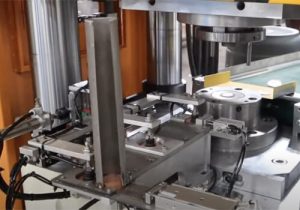
Newcomer Pitfalls – 5 Common Mistakes:
Buying by Price Alone: The cheapest 315T may lack essentials (e.g. it might be hand-pump or single-speed). Upgrading such a machine later (adding a CNC controller or extra pump) can cost USD $4,200–11,300, negating the initial savings.
Blindly Choosing Maximum Capacity: Conversely, some buyers pick 500T “just in case” without analyzing needs. If you only ever press small bars (<500 g), a 500T press will sit mostly idle (low-load operations are inefficient and consume unnecessary power). Match size to your actual workload for best ROI
harsle.com.
Ignoring After-Sales Support: Precious metal presses need quick service (e.g. same-day hydraulic repair) because downtime is costly. Avoid obscure brands with no local service network. Check warranty terms and ask for references from other minting operations. A little extra cost for a reputable supplier is usually justified.
Overlooking Die/Tool Compatibility: Always verify your tooling fits the machine. A common mistake is buying a press without checking that existing molds will clear the ram and base. If you change press type (e.g. manual vs power), your dies or fixtures might need reworking. Measure your dies’ width, length, and any side-clearances, and ensure the press table and cylinder can accommodate them.
Site Preparation Neglect: A 500T press weighs ~10–15 tonnes and is ~3.5×2×2.5 m in size. Make sure your floor is strong (≥20 kN/m² bearing) and your doors/ceiling are high enough for transport. Many buyers have faced delays (or even wasted money shipping a machine that didn’t fit). Prepare in advance: reinforce flooring if needed and confirm clearances before the press arrives.
In all cases, the best approach is to list your requirements first – bar size range, daily volume, alloy purity – then get detailed proposals from multiple press manufacturers. Compare not just tonnage and price, but machine specifications and service terms. This due diligence will pay off in reliable operations and controlled costs.
Key Takeaways
Match Ton to Product: Use 315T for small (≤500 g) or very thin bars; use 500T for heavy (≥1 kg) and thick bars. If you frequently form large or recycled-gold ingots, 500T is the safe choice.
Match Capacity to Scale: For modest daily outputs or pilot lines, 315T can be economical. For sustained high throughput (100+ bars/day) or 1–5 kg products, 500T ensures consistent quality and speed.
Consider Long-Term Value: Over 3–5 years, a 500T press often costs less overall due to higher yield and less downtime. It also allows entry into higher-end markets (e.g. LBMA-standard bars) that demand perfect density
pacificpreciousmetals.com. Think of the press as a long-lived investment – choose for lifetime return, not just immediate savings.
Avoid Common Traps: Don’t just trust the rated tonnage – verify actual force. Never run a press at >80–85% of its capacity long-term
harsle.com. Ensure proper controls, safety, and support. And remember: engineering expertise matters. Consulting with a trusted metalworking specialist or using tried-and-true design criteria (rather than guessing) will guide you to the right press.
Ultimately, the goal is stable, high-quality bar production with controllable costs. By carefully analyzing your needs and understanding how tonnage affects compaction, surface finish, and throughput, you can select a hydraulic press that keeps bars and budgets on track.
 © Copyright 2008-2026 Superb Electromachinery Co., Limited