
300 ton Hydraulic Press
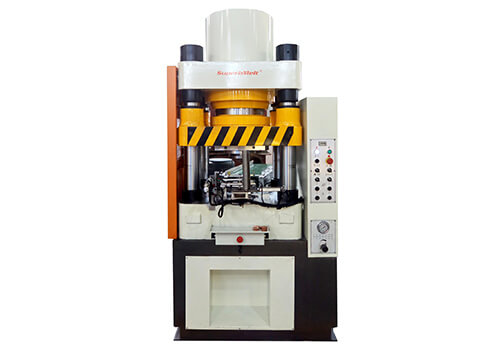
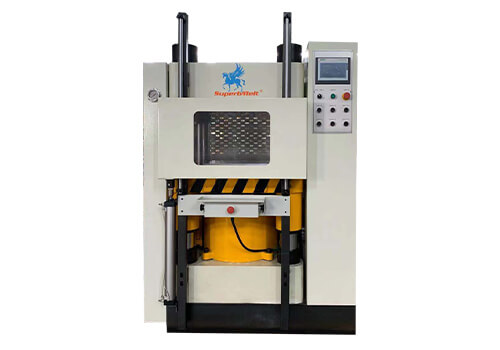
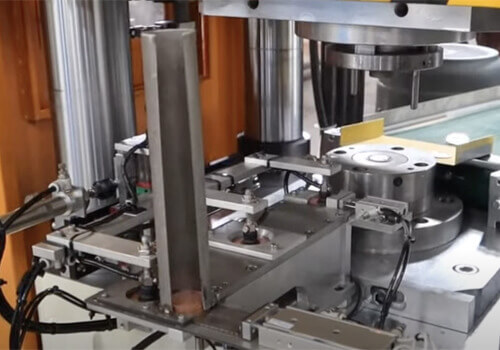
Superbmelt 300 ton hydraulic press machine is used for processing complex metal shapes in a short time and large volumes. It is suitable for high volume productivity of forging, clinching, moulding, punching and so on. For each of these applications, the press plate and dies may be different but the structure is the same. Superbmelt 300 ton hydraulic press has the capacity of processing up to 300 tons of metals.
Superbmelt hydraulic press machine works with metals such as titanium, silver, gold, aluminium, copper, iron, tin, tungsten, etc. The stroke of the working table and the system pressure helps to regulate the stamping process. The entire 300 ton pressing machine requires about 4kw to 11kw of energy for an effective stamping process.
Metal production industries opt for machine presses because of its high level of automation, quick processing and easy maintenance. Superbmelt hydraulic press machine for sale offers all these and more.

| Item | Unit | SPB-300TP | SPB-300TS | |
| Photo | 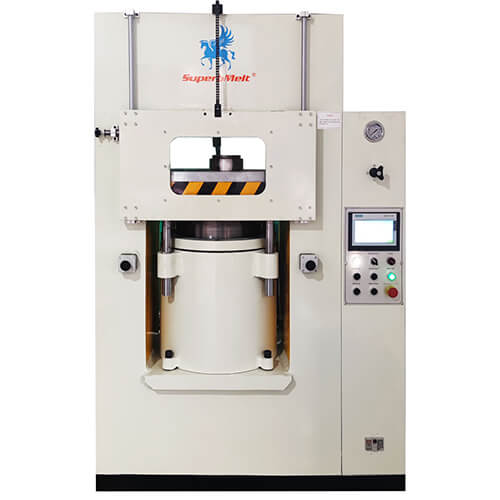 | 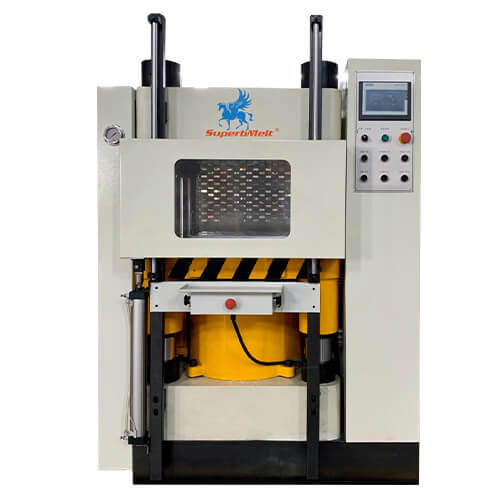 | ||
| Rated capacity | Ton | 300 | 300 | |
| Max. system pressure | Mpa | 24 | 24 | |
| Max. stroke of working table | mm | 150 | 150 | |
| Open height | mm | 380 | 400 | |
| Height of movable working table | mm | 1080 | 940 | |
| Upward speed of movable working table | mm/s | 80 | 210 | |
| Returning speed of movable table | mm/s | 90 | 210 | |
| Movable working table size | L-R | mm | 580 | 560 |
| F-B | mm | 540 | 560 | |
| Overall dimension | L-R | mm | 1200 | 1260 |
| F-B | mm | 1165 | 1340 | |
| H | mm | 1895 | 2340 | |
| Motor power | kw | 7.5 | 16 | |
| Weight (Approx.) | kg | 3300 | 3620 | |
- Superbmelt 300 ton hydraulic press machine is suitable for pressing up to 300 tons of precious and base metals. This is suitable for all coin minting and gold bar productions, forging, deep drawing and other metal forming operations.
- The 300 ton hydraulic press machine has a higher versatility than the mechanical press. This means that the same machine can be used for a large number of applications.
- The servo motor driven system controls the speed and pressure of stamping so that users have high control over the stamping process. The servo motor driven system allows the machine to move stably. The stability is because of the hydraulic components that are designed for various environments.
- Superbmelt 300 ton hydraulic press is automated and easy to use. The machine has a PLC control unit that allows you to set the speed and pressure of pressing. This feature is absent in other methods used in metal forming operations.
- Superbmelt 300 ton hydraulic stamping machine is energy-efficient, about 7.5kw to 16kw of energy is required. As a result of this, a minimum of 40% of energy is saved.
- The open height of 320mm and the height of the working table is 960mm. This feature makes it convenient to use and prevents the user from experiencing physical strain.
- The operating features are simple with minimal buttons, which means the Superbmelt hydraulic press machine is user friendly.
- The compact design of the press machine means that minimal space is required.
- The inbuilt overload protection makes it safe to use compared to mechanical presses.
Why SuperbMelt 300 ton Hydraulic Press


Any Question About SuperbMelt 300 ton Hydraulic Press
300-Ton Hydraulic Press Guide: For Gold & Silver Bar Production
What Does a 300-Ton Hydraulic Press Actually Mean?
1.1, Definition of 300-Ton Pressing Force
1.2, Relationship Between Tonnage, Pressure & Metal Density
- Tonnage (Force): Serves as the “power foundation”—higher tonnage delivers greater compressive force to overcome internal friction between metal particles, eliminate voids, and densify the material. A 300-ton press provides sufficient force to compact molten or cast metal blanks into dense bars, while insufficient tonnage leaves internal pores, reducing both density and structural integrity.
- Pressure (Force per Unit Area): Directly dictates densification efficiency. For larger or thicker bars (with greater cross-sectional area), higher tonnage is required to maintain the pressure needed for full densification. For example, pressing a 5kg gold bar (larger surface area) demands more tonnage than a 1kg bar to reach the same 19.32 g/cm³ density.
- Metal Density: The ultimate quality indicator. Under-dense bars fail to meet industry standards (e.g., LBMA requirements for investment-grade bullion), leading to rejected batches, discounted sales, or loss of market credibility. A 300-ton press strikes a balance between pressure output and energy efficiency, optimized for mid-sized gold and silver bars.
1.3, Difference Between 300T, 315T and 500T in Real Production
| Performance Metric | 300T Hydraulic Press | 315T Hydraulic Press | 500T Hydraulic Press |
|---|---|---|---|
| Effective Force Range | 240–270 tons | 252–283.5 tons | 400–450 tons |
| Densification Capability | Ideal for bars ≤5kg (gold) / ≤30kg (silver); achieves 99.5%+ of target density | Slightly higher pressure reserve for 5kg gold bars; 99.7%+ density consistency for thick bars | Excels at bars ≥5kg (gold) / ≥30kg (silver); maintains 99.8%+ density even for large/thick profiles |
| Bar Size Flexibility | Limited to mid-sized bars; struggles with 12.5kg gold bars or 50kg silver bars | Moderate flexibility; handles 12.5kg gold bars with reduced cycle time | High flexibility; supports all standard bullion sizes + custom large bars (e.g., 20kg gold, 100kg silver) |
| Continuous Operation Stability | Suitable for small-to-medium batches (≤100 bars/day); prone to overheating under heavy load | Better for medium batches (100–200 bars/day); more stable under prolonged use | Designed for large-scale production (≥200 bars/day); 24/7 operation capability with minimal downtime |
| Application Focus | Small refineries, jewelry workshops, test production, regional market supply | Medium refineries, regional mints, steady mid-volume orders, semi-premium bullion | Large refineries, international bullion producers, high-volume OEM/ODM, LBMA-compliant premium bullion |
What Sizes of Gold & Silver Bars Can a 300T Press Produce?
2.1, Standard Gold Bar Sizes Supported (1kg, 2kg, 5kg, 12.5kg)
| Gold Bar Size | Feasibility | Key Production Notes |
|---|---|---|
| 1kg (Typical Dimensions: 110mm×55mm×10mm) | Fully Supported | Ideal match for 300T press; achieves target density (19.28–19.32 g/cm³) in 1 cycle (2–3 minutes); yield rate ≥99% |
| 2kg (Typical Dimensions: 150mm×70mm×12mm) | Fully Supported | Requires minimal pressure adjustment; consistent density across the bar; no edge defects or warping |
| 5kg (Typical Dimensions: 200mm×100mm×15mm) | Supported (With Limitations) | Achieves 19.25–19.30 g/cm³ density (meets most regional standards); requires a 10–15 second pressure hold to eliminate internal voids; yield rate 93–95% |
| 12.5kg (LBMA Standard: 250mm×100mm×20mm) | Partially Supported (Not Recommended) | Struggles with full densification (density ≤19.20 g/cm³); high risk of internal cracks, surface unevenness, or porosity; fails LBMA compliance for investment-grade bullion |
2.2, Standard Silver Bar Sizes Supported (5kg, 15kg, 30kg)
| Silver Bar Size | Feasibility | Key Production Notes |
|---|---|---|
| 5kg (Typical Dimensions: 120mm×60mm×15mm) | Fully Supported | Excellent density (10.45–10.50 g/cm³); fast cycle time (1.5–2 minutes/bar); yield rate ≥99% |
| 15kg (Typical Dimensions: 180mm×90mm×20mm) | Fully Supported | Optimal size for 300T press; consistent surface finish and edge sharpness; no post-processing required |
| 30kg (Typical Dimensions: 250mm×120mm×25mm) | Supported (With Limitations) | Achieves 10.40–10.45 g/cm³ density; requires high-strength steel molds to prevent surface porosity; longer cooling time (5 minutes/bar); yield rate 94–96% |
| 50kg+ | Not Supported | Insufficient pressure leads to severe density issues (≤10.30 g/cm³) and structural weakness; rejection rate ≥30% |
2.3, Maximum Bar Thickness and Mold Size Limitations
- Maximum Bar Thickness:
- Gold: 15mm (for consistent density); thickness exceeding 15mm results in uneven pressure distribution (higher density at the top, lower at the bottom) and surface defects.
- Silver: 25mm (due to better malleability); thickness above 25mm leads to surface indentations, edge rounding, or internal porosity.
- Mold Size Limitations:
- Recommended Mold Cavity Area: ≤20,000 mm² (e.g., 200mm×100mm for 5kg gold bars) to ensure uniform pressure.
- Maximum Mold Dimensions: Length ≤300mm, width ≤150mm (limited by the press’s table size, typically 600mm×400mm for standard 300T models).
- Mold Structural Strength: Must use high-strength steel (H13 or carbide-reinforced steel) with a minimum tensile strength of 1,800 MPa to withstand 300-ton pressure; flimsy molds cause bar deformation or permanent mold damage.
Key Technical Factors That Affect Final Bar Size
3.1, Mold Design, Cavity Size & Structural Strength
- Cavity Size Precision: Mold cavities must be machined to ±0.1mm tolerance to ensure bar dimensions meet industry standards. For example, a 1kg gold bar mold with a 0.2mm oversize cavity will produce bars that are 2–3% heavier than nominal weight, leading to costly material waste.
- Cavity Structure:
- Straight-walled cavities work well for small bars (≤2kg gold) but may cause demolding issues for thicker bars.
- Tapered cavities (1–2° draft angle) reduce friction during demolding, preserving edge sharpness—critical for premium or investment-grade bars.
- Bottom vents (0.5mm diameter) eliminate air trapped between the metal blank and mold, preventing surface porosity and ensuring full cavity filling.
- Mold Structural Strength: Molds for 300T presses must withstand extreme compressive force. Low-quality molds deform under pressure, resulting in inconsistent bar sizes (e.g., tapered bars instead of rectangular ones) or permanent damage. Investing in high-strength steel molds (H13 or equivalent) extends mold life and ensures size consistency.
3.2, Material Type & Purity (Gold vs Silver Compression Behavior)
- Gold:
- Higher density (19.32 g/cm³) and hardness require more pressure to densify. Pure gold (999.9) is softer than alloyed gold (e.g., 995), but even pure gold needs sufficient pressure to eliminate voids.
- Purity Impact: Gold with impurities (e.g., 950 gold) has higher internal friction, making it harder to compact. A 300T press may only reliably produce 2kg bars (instead of 5kg) for lower-purity gold due to reduced malleability.
- Silver:
- Lower density (10.5 g/cm³) and higher malleability allow for larger bar sizes. Silver flows more easily into mold cavities, even at the 300T press’s pressure limit.
- Purity Impact: Silver purity (999 vs 995) has minimal effect on compression—300T can handle 30kg bars regardless of minor impurities, as silver’s softness compensates for internal friction.
3.3, Required Density, Surface Finish & Edge Sharpness
- Density Requirements: If your application demands LBMA-compliant density (19.32 g/cm³ for gold), the 300T press is restricted to ≤2kg gold bars. For regional standards (19.20 g/cm³ minimum), it can handle up to 5kg gold bars.
- Surface Finish: High-gloss or mirror-finish bars require precise pressure control and smooth mold surfaces. The 300T press can achieve Ra ≤0.8μm surface roughness for ≤2kg gold bars, but thicker bars may have uneven surfaces due to pressure distribution issues—requiring post-processing (e.g., grinding) that increases production time and cost.
- Edge Sharpness: Premium bars require crisp, burr-free edges. The 300T press can produce sharp edges for bars ≤15mm thick, but thicker bars (≥20mm) will have rounded edges due to metal flow limitations. This may disqualify bars from premium markets or require additional trimming.
Production Capacity & Output Efficiency
4.1, Single-Cycle Pressing Time
| Bar Type | Single-Cycle Time (Semi-Automatic) | Single-Cycle Time (Fully Automatic) | Cycle Breakdown (Loading → Pressing → Holding → Cooling → Demolding) |
|---|---|---|---|
| 1kg Gold Bar | 2–3 minutes | 1.5–2 minutes | 15s → 30s → 10s → 60s → 5s |
| 5kg Gold Bar | 4–5 minutes | 3–4 minutes | 20s → 60s → 20s → 120s → 10s |
| 15kg Silver Bar | 3–4 minutes | 2–3 minutes | 15s → 45s → 15s → 90s → 5s |
| 30kg Silver Bar | 5–6 minutes | 4–5 minutes | 20s → 75s → 25s → 180s → 10s |
4.2, Daily Output for Gold Bars vs Silver Bars
| Bar Size | Daily Output (Gold) | Daily Output (Silver) | Typical Rejection Rate |
|---|---|---|---|
| 1kg | 120–150 bars | — | 1–2% (density/surface issues) |
| 2kg | 80–100 bars | — | 2–3% |
| 5kg | 30–40 bars | — | 5–7% (higher risk of internal cracks) |
| 5kg | — | 100–120 bars | 1–2% |
| 15kg | — | 60–80 bars | 2–3% |
| 30kg | — | 25–35 bars | 4–6% (porosity or edge defects) |
4.3, Integration with Casting, Cooling & Handling Systems
- Casting Integration: Direct integration with a continuous casting machine eliminates manual transfer of metal blanks, reducing loading time by 50% and minimizing heat loss (critical for maintaining metal flowability). For example, a 300T press paired with a 5kg gold casting machine creates a seamless “cast → press → cool” workflow, cutting 1kg gold bar cycle time from 2.5 minutes to 1.8 minutes and increasing daily output by 25%. Without integration, manual transfer adds 30-45 seconds per blank and raises the risk of contamination or blank misalignment.
- Cooling Systems: Integrated water-cooled molds or air-cooling tunnels reduce cooling time by 30-40%. For 5kg gold bars, this shortens cycle time from 5 minutes to 3.5 minutes, boosting daily output from 30 to 45 bars. Passive cooling (relying on ambient air) not only slows production but also increases the risk of bar warping—especially for thick silver bars (≥25mm). Investing in a dedicated cooling system delivers a rapid ROI by improving throughput and reducing rejection rates.
- Handling Systems: Automated robotic arms or conveyor belts for loading/unloading reduce labor costs and human error. A semi-automatic 300T press with manual handling requires 1 operator per shift, while integrating a robotic arm allows 1 operator to manage 2 presses simultaneously. Additionally, automated handling minimizes contact with hot bars, preserving surface finish and reducing the risk of scratches or dents that require rework.
Is a 300-Ton Hydraulic Press the Right Choice for Your Factory?
5.1, Ideal Applications: Refineries, Jewelry Chains, Small Mints
- Small-to-Medium Refineries: Process 50-200kg of gold/silver daily, producing 1kg-5kg gold bars and 5kg-30kg silver bars for regional markets. These facilities prioritize cost-efficiency over large-scale output and serve local investors, jewelers, or industrial clients who don’t require LBMA/OEM compliance.
- Jewelry Chains & Manufacturers: Produce in-house gold/silver bars (1kg-2kg) for jewelry production, reducing reliance on external suppliers and lowering material costs. The 300T press’s compact footprint (typically 2.5m×1.5m×2m) fits in workshop spaces, and its flexibility supports custom bar sizes for specialized designs (e.g., thin gold bars for necklaces).
- Small Mints & Precious Metal Recyclers: Cater to niche markets (e.g., custom commemorative bars, recycled gold bars) with low-to-moderate volume. The press’s lower upfront cost (vs 500T models) makes it accessible for startups, while its ability to handle standard sizes ensures compatibility with market demand.
- Industrial Material Suppliers: Produce silver bars (15kg-30kg) for electronics, medical, or chemical industries. These sectors prioritize consistent density and dimensional accuracy over premium finish—both of which the 300T press delivers reliably at a competitive cost.
5.2, When 300T Is Fully Sufficient—and When You Should Upgrade
When 300T Is the Perfect Fit:
- Your core product line is 1kg-2kg gold bars or 5kg-15kg silver bars, with no plans to expand to larger sizes within 3 years.
- Daily output requirements are ≤150 gold bars or ≤120 silver bars (8-hour shift), and you don’t anticipate exceeding this volume.
- Target markets accept regional density standards (e.g., 19.20 g/cm³ minimum for gold) rather than strict LBMA/OEM requirements (19.32 g/cm³).
- Budget is constrained (300T costs 30-40% less than 500T), and long-term scalability is not a strategic priority.
- Workshop space is limited (300T requires ~10㎡ installation area vs 15-20㎡ for 500T), or electrical capacity is restricted (300T uses 15-25kW vs 30-45kW for 500T).
When You Should Upgrade to 315T or 500T:
- You need to produce 5kg+ gold bars or 30kg+ silver bars with LBMA-compliant density (19.32 g/cm³ for gold) to access premium markets.
- Daily output needs exceed 150 gold bars or 120 silver bars—300T will bottleneck production, leading to overtime costs, delayed orders, or lost business.
- You’re securing OEM/ODM orders for large bullion (e.g., 12.5kg gold bars for banks, 50kg silver bars for industrial clients) that require consistent quality at scale.
- Raw material is low-purity or recycled (e.g., scrap gold with impurities), which requires higher pressure to eliminate voids and ensure uniform density.
- You plan to expand production by 50%+ within 1-2 years—upgrading later costs more than investing in a larger press upfront (includes new equipment, installation, and downtime).
5.3, Production Scalability & Future Capacity Planning
- Short-Term (1-2 Years): If your business is growing at 10-15% annually, the 300T press can handle expanded output via:
- Adding a second 8-hour shift (increasing daily output by 80-90% without equipment upgrades).
- Upgrading to fully automatic loading/unloading (reducing cycle time by 20-30% and cutting labor costs).
- Optimizing mold design (e.g., multi-cavity molds for small bars, which cut per-unit cycle time by 40-50%).
- Long-Term (3+ Years): If growth exceeds 20% annually, the 300T press will hit a “hard capacity ceiling” (max daily output for 1kg gold bars is ~200 with 2 shifts). To avoid bottlenecks:
- If space and budget allow, add a second 300T press (lower upfront cost than replacing with 500T, but higher long-term labor/energy costs).
- If large-bar orders are increasing, replace the 300T with a 500T press (consolidates production, reduces per-unit costs, and supports larger sizes).
- Critical Planning Tip: When installing a 300T press, reserve infrastructure for future upgrades:
- Electrical Capacity: Ensure the workshop can support a 500T press (typically 30-40kW vs 15-25kW for 300T) by running extra wiring during initial installation.
- Floor Space: Leave 5-10㎡ adjacent to the 300T press for additional equipment (e.g., a second press, integrated cooling system, or robotic handling).
- Mold Compatibility: Invest in molds that can be reused with a 315T/500T press (same cavity design, higher-strength material) to avoid retooling costs later.
300T vs 315T vs 500T: How to Make the Right Investment Decision
6.1 Bar Size Range & Output Comparison
| Production Metric | 300T Hydraulic Press | 315T Hydraulic Press | 500T Hydraulic Press |
|---|---|---|---|
| Maximum Gold Bar Size (Reliable) | 5kg (19.25–19.30 g/cm³) | 12.5kg (19.28–19.32 g/cm³) | 20kg+ (19.32 g/cm³) |
| Maximum Silver Bar Size (Reliable) | 30kg (10.40–10.45 g/cm³) | 50kg (10.48–10.50 g/cm³) | 100kg+ (10.50 g/cm³) |
| Daily Output (1kg Gold Bars) | 120–150 bars | 180–220 bars | 300–350 bars |
| Daily Output (15kg Silver Bars) | 60–80 bars | 100–120 bars | 200–250 bars |
| LBMA Compliance | No (for gold >2kg) | Yes (for gold ≤12.5kg) | Yes (all standard sizes) |
| Custom Bar Support | Limited (≤15mm thickness) | Moderate (≤25mm thickness) | Full (≤50mm thickness) |
| Rejection Rate (Standard Sizes) | 2–5% | 1–3% | 0.5–2% |
6.2 Energy Consumption & Operating Cost Differences
| Cost Category | 300T Hydraulic Press | 315T Hydraulic Press | 500T Hydraulic Press |
|---|---|---|---|
| Power Requirement | 15–25kW | 20–30kW | 30–45kW |
| Hourly Energy Cost (0.15 USD/kWh) | 2.25–3.75 USD | 3.00–4.50 USD | 4.50–6.75 USD |
| Labor Requirement | 1 operator/shift | 1–2 operators/shift | 2 operators/shift |
| Annual Maintenance Cost | 2,000–3,000 USD | 3,000–4,500 USD | 5,000–7,000 USD |
| Per-Unit Operating Cost (1kg Gold Bar) | 1.20–1.50 USD | 1.00–1.20 USD | 0.80–1.00 USD |
- 300T total operating cost: ~150,000 USD
- 500T total operating cost: ~100,000 USD
6.3 Equipment Cost, ROI & Long-Term Business Value
| Financial Metric | 300T Hydraulic Press | 315T Hydraulic Press | 500T Hydraulic Press |
|---|---|---|---|
| Upfront Equipment Cost | 25,000–40,000 USD | 40,000–60,000 USD | 70,000–100,000 USD |
| Installation Cost | 3,000–5,000 USD | 5,000–8,000 USD | 10,000–15,000 USD |
| Total Initial Investment | 28,000–45,000 USD | 45,000–68,000 USD | 80,000–115,000 USD |
| Break-Even Point (1kg Gold Bars) | 20,000–30,000 bars | 30,000–40,000 bars | 40,000–50,000 bars |
| ROI Period (Annual Output: 50,000 bars) | 1–1.5 years | 1.5–2 years | 2–2.5 years |
| Estimated Service Life | 8–10 years | 10–12 years | 12–15 years |
| Resale Value (5 Years Old) | 8,000–12,000 USD | 15,000–20,000 USD | 30,000–40,000 USD |
- 300T: Best for short-term ROI (≤2 years) and small-scale operations. However, its limited scalability means you may need to replace it within 5 years if your business grows—resulting in “churn cost” (new equipment + installation + downtime). Ideal for startups or businesses with stable, low-volume demand.
- 315T: Balances ROI and scalability. It serves mid-sized production for 8–10 years and can handle growing large-bar orders, reducing the need for early replacement. Perfect for businesses with uncertain growth trajectories or plans to enter mid-premium markets.
- 500T: Highest initial investment but lowest long-term cost. Its 12–15 year service life, high resale value, and ability to capture premium OEM/LBMA orders make it the most valuable asset for businesses targeting long-term market leadership. Ideal for established refineries or those with confirmed high-volume orders.
Final Decision Framework
- Map Your Product Mix: List your current and projected bar sizes (e.g., 80% 1kg gold, 20% 5kg gold). If large bars (≥5kg gold) are ≥30% of your mix, eliminate 300T.
- Calculate Annual Volume: If annual output ≤50,000 bars, 300T/315T is sufficient. If ≥100,000 bars, 500T is more cost-effective.
- Evaluate Growth Trajectory: If you expect ≥20% annual growth, choose 315T/500T to avoid bottlenecks. If growth is ≤10%, 300T is the most prudent choice.
Conclusion
FAQ Guide of Hydraulic Press
- 1. How should I determine what type of hydraulic press I need for my application?
- 2. How does a hydraulic press machine function?
- 3. Do you provide customized solutions?
- 4. How much pressure should a hydraulic press have?
- 5. How many types of hydraulic press machines are there?
- 6. What makes hydraulic presses popular in industrial production?
- 7. Between the hydraulic press machine and the mechanical press machine: which is better?
- 8. Is the hydraulic press machine more energy efficient?
- 9. What kind of experience does SuperbMelt have building hydraulic press solutions?
- 10. What type of controls come with SuperbMelt hydraulic press?
- 11. What type of power will SuperbMelt machine require?
- 12. What types of applications have been achieved with SuperbMelt machines?
- 13. What are the different types of hydraulic presses offered by SuperbMelt?
- 14. How safe is hydraulic press in industrial production?
- 15. How durable is the hydraulic press?
- 16. What are some advantages and application examples of hydraulic press?
- 17. What is the difference between hydraulic press and power press?
- 18. Does SuperbMelt provide automated solutions?
- 19. How do I choose a hydraulic press?
- 20. What if we face a problem in the workmanship after installation?
- 21. What does SuperbMelt engineers offer?
1. How should I determine what type of hydraulic press I need for my application?
A hydraulic press is a machine press that uses a hydraulic cylinder that further generates a compressive force. The complete process depends on certain physics principles and works through different mechanical processes.
When trying to determine a hydraulic press for a certain application, you must know tonnages. So, it’s important to understand the tonnage requirement before selecting the type. Let’s have a look at types of hydraulic presses.
- Movable Table Hydraulic Press
This type of hydraulic press is also known as the H-frame press, which features a stationary frame and manual movable table. It makes it easy to carry overhead loads. The movable table hydraulic press is available in tonnages up to 100-200 tons. This type is usually used for assembling, extracting, straightening, and fabrication. The table is mounted over rollers for efficient top head loading and positioning. It is known for its greater efficiency and smooth operation.
- Movable Frame Hydraulic Press
The movable frame hydraulic press includes a large fixed bed and movable frame, and all its presses include a power frame and work head transverse. It can feature a stationary table with an operational movable frame and a cylinder. These are useful for straightening plates, fabricating sheet metal, and other processes like assembling, extracting, bending, and testing applications. There are available in different tonnages between 150 and 600 tons. A 300-ton hydraulic press is considered more efficient for various applications.
- Air Operated Hydraulic Press
The air-operated hydraulic press has the capability to eliminate hand pumping as it works with an air pressure of specific measurement. The by-pass hole prevents it from excessive ram extension. This hydraulic press type is best for time-saving due to its rapid RAM approach. It has double air pumps that work with a double pumping procedure for faster pressing. The tonnage capacity of an air-operated hydraulic press can vary from 25/50 tons to 200 tons.
There are various options available in SuperbMelt, so if you are planning to buy the best 300 ton hydraulic press, it’s better to opt from their site.
2. How does a hydraulic press machine function?
The hydraulic press machine works based on Pascal’s Principle. According to the principle, when pressure is applied to the confined fluid, the changes in pressure occur throughout the entire fluid. Pascal’s principle depends on three kinetics: pressure, force, and area; the hydraulic press functions depending on these major factors.
The initial process starts with enforcing hydraulic fluid force into a double-action piston. When more force is applied, the compressive force in the small cylinder pushes the fluid into the larger cylinder. The frequent movement of the larger piston forces the fluid to flow back into the smaller piston cylinder.
The mechanical passage of these fluids between the pistons initiates increased pressure, which produces a mechanical force that drives the anvil on a hydraulic press downward upon the workpiece, which is deformed to give it the desired shape. After the completion of the movement, the pressure gets released, and the anvil returns to its original state.
The working function of the hydraulic press is best suitable for various operations such as forging, clinching, molding, blanking, punching, deep drawing, and metal forming. A 300 ton hydraulic press is best suitable for the above process. To get more information about the working functions of different hydraulic presses, get in touch with SuperbMelt.
3. Do you provide customized solutions?
If you are looking for the best-customized solutions advanced in automation techniques, then visit the SuperbMelt site. They are well-known for providing automated solutions which are efficient and cost-effective.
- Automated Coin Minting Line Solution
Our company is recognized for providing professional solutions to clients. Coin minting solution is one of our professional solutions, and we are considered the best coin minting solution provider across the world concerning our experience records. Our hydraulic coin press machine is designed with a steel fabricated body specially designed to mint coins, gold, and silver.
It can press up to 150 tons of metals. Our machine can be described as an upstroke coining press because it features an extra hydraulic cylinder for return stroke and delivers a RAM travel speed. Due to its advanced features, it provides the best minting solution for gold, silver, and bar metals as per the market’s demand.
Therefore, you can opt for our service provider as we serve with excellence and experience for a one-stop service solution. Our firm has experience of more than a decade in providing this service, on-site training, and technical support.
- Automated Coin Stamping Solution
This is another automated solution the company provides, and it is best known for its wide use in the coin stamping process throughout the world. The hydraulic coin press machine has various advanced features with perfect tonnage and pressure requirements.
SuperbMelt even provides various other customization solutions and other services for different operational applications. Even if you are planning to buy hydraulic press machines for these solutions, you can check the availability of various machines as per your requirement. An automatic hydraulic press machine is even available in different price ranges.
4. How much pressure should a hydraulic press have?
The pressure of the hydraulic press depends upon the type of application. Different types of hydraulic pressure machines come with different pressure capacities. The pressure is calculated by finding piston area from piston diameter, and then the pressure is multiplied by cylinder area. The international standard in high-pressure hydraulic tools is 700 to 10,000 psi maximum. It is advised to purchase a hydraulic press up to 300 tons. The hydraulic machine manufacturer knows better to stabilize the pressure in the machines.
You can easily find a 300 tons hydraulic press in SuperbMelt in affordable ranges.
5. How many types of hydraulic press machines are there?
- Four-Column Hydraulic Press
This kind of hydraulic press is basically used for different materials, and it is eligible for various pressing technologies such as blending, punching, clinching, etc.
- Single Column Hydraulic Press
According to its name type, it constitutes a single column and a C-type frame. It works as a small hydraulic press with a multi-functional medium which is suitable for correcting shaft parts and profiles. This is also known as the C-frame press.
- Vertical Hydraulic Press
This vertical hydraulic press of hydraulic press has two columns with an overarm connected with it. In this working process, the pressure is applied vertically.
- Horizontal Hydraulic Press
In this type of hydraulic press, the workpiece lies between the vertical plate, and here the pressure is applied horizontally, which is parallel to the axis of the hydraulic press machine.
- Universal Hydraulic Press
As the name suggests, this machine type is used for various types of pressing processes such as forging, punching, etc.
You can even prefer custom hydraulic press machines as per your requirement.
6. What makes hydraulic presses popular in industrial production?
The hydraulic presses are popularized in industrial production due to their advanced features and application. It plays a vital role in the manufacturing and production process. The hydraulic press machines are known for their versatile nature as they can be used for the various operational processes in the manufacturing units.
It operates effectively as the machines are designed for smooth pressure with constant RAM force. The hydraulic machines are used for necessary industrial processes such as forming, pressing, bending, stretching, assembling, embossing, and compaction.
The desired work can be completed within limited time and pressure as per the requirement, which further helps in the production process. Therefore, hydraulic techniques are getting popularized in different industries such as cosmetic, automotive, electric, and home appliance industries, etc. 300 ton press machines are usually preferred in industrial processes.
7. Between the hydraulic press machine and the mechanical press machine: which is better?
When comparing the hydraulic press machine with the mechanical press machine, you can easily differentiate them based on their properties, features, and working. According to the research, the hydraulic press machine seemed to be much better than the mechanical press machine by studying its versatility. No doubt that the mechanical press machine offers a good rate of production, but when you look after the working process, the hydraulic press machine has the capability to function efficiently even in a complex process.
Hydraulic press machines are known for performing automation processes with greater efficiency. It can do several complex tasks such as speedy automatic minting, coin making, logo stamping, etc. These automation techniques are better performed by 300 tons hydraulic press. Therefore it is widely preferred in the industrial sectors.
8. Is the hydraulic press machine more energy efficient?
The hydraulic press machine is more energy-efficient than other traditional press machines. The power consumption of the hydraulic press machine can be controlled as necessary by adjusting the pressure. The pressure level determines the power consumption. Therefore, adjusting pressure in hydraulic press machines can save up to 60 percent power. The energy-efficient factor is primarily noticed in automated hydraulic press machines. Hence they are widely used in industrial operations. A 300 ton press machine is more energy-efficient.
The SuperbMelt has got the best energy-efficient hydraulic press in reasonable price ranges. Therefore, for more details, contact their professionals. You can check the 300 ton hydraulic press price from the SuperbMelt online store.
9. What kind of experience does SuperbMelt have building hydraulic press solutions?
The SuperbMelt has experience of more than a decade in building hydraulic press solutions. Their experience records speak about their diligence and excellent service and solutions. Their manufacturers and experts go through detailed research and then implement their strategies and plan to build the solutions to meet the market’s value. All the sources and materials they use are of high quality and advanced features.
The experts are always ready for the upgradation of solutions to match the current need of the technological advancement era. All the services and solutions have special certification and are approved by ISO CE SGS. The firm also received feedback from trusted customers, emerging in its business in past years. Therefore, to get the versatile hydraulic press solutions to contact the experts of SuperbMelt. The 300 ton hydraulic press is best known for its versatile qualities.
10. What type of controls come with SuperbMelt hydraulic press?
The Hydraulic press machine is associated with a motor system that drives the entire process with the help of components like pistons, cylinders, and pipes. The hydraulic press has many control components, such as a hydraulic motor, direction control valve, pressure relief valve, pressure gauge, and limit switch. These components feature a PLC system in the hydraulic machine.
The control system makes the work process more efficient and convenient. These unique features are hardly noticed in any other mechanical press machines. The servo-driven technology implemented in our hydraulic system is more energy-efficient and can save energy up to 50 to 60 percent.
11. What type of power will SuperbMelt machine require?
The SuperbMelt hydraulic machine primarily functions with the help of kinetic power or fluid power. Fluid power is the special requirement type for the hydraulic press machines, which drives the workflow. The hydraulic fluid is pumped into the cylinders and motor with a given pressure in the initial process.
The motor further requires electric power for operating. Therefore, fluid power is a specialized usage of fluids under pressure that generates, controls, and transmits power. It works step-wise by a pressurized fluid bearing technique directly on a piston in a cylinder or a fluid motor.
12. What types of applications have been achieved with SuperbMelt machines?
The SuperbMelt machines have various applications based on their advanced features. The machines are capable of providing various services and solutions. For example, hydraulic press techniques are used for coin making, logo stamping, and minting gold and silver coins, medals, and bars. It even offers the best jewelry chain-making machines for creating gold, platinum, silver, and hard alloy chains. They even have other important types of machinery such as laser machines, metal casting machines, and induction melting furnaces.
Due to the availability of these machinery types, they have a huge range of applications, and hence they are preferred by various industries. The SuperbMelt solutions even got great applications; they solve different problems and provide quality solutions. For example, the coin minting solution of SuperbMelt is known for building several coin-making lines across the world. Their experience and professionalism state the supremacy they achieved with their machines. Go through the hydraulic press machine price and get your order.
13. What are the different types of hydraulic presses offered by SuperbMelt?
Based on the structural form, the SuperbMelt hydraulic press machines can be differentiated into
- Four Column Hydraulic Press
This structural type is suitable for pressing various substances such as plastic materials, forming powdered products, cold extrusion metal forming, sheet drawing, bending, penetration, transverse pressing, and correction processes. The four-column columns can be divided into two-beam, three beam, and four beam hydraulic presses.
- C Frame Hydraulic Press
These hydraulic presses have an extendable working range, enabling lengthened hydraulic cylinder stroke. It even enables pre-set working pressure. The maximum retractability is from 260 nm to 800 nm.
- Horizontal Hydraulic Press
This is considered a multi-purpose hydraulic press with various properties such as assembling, disassembling, straightening, compressing, stretching, bending, and punching. The working table of this hydraulic press is movable, which makes it more convenient to use.
- Two Pillar Hydraulic Press
This unique hydraulic press is suitable for different operations such as bending, pressing, and shaping various parts. It is even used for metal powder products forming.
The hydraulic press is classified into punching, power forming, metal forming, pressing, extrusion, and other processes based on the application.
The SuperbMelt hydraulic presses are also divided based on tonnages. Different types of machines come with different tonnage and pressure management. Therefore, the hydraulic presses are available in different tonnages. 300 ton press for sale available on the online site, for purchasing you can browse easily through it.
14. How safe is hydraulic press in industrial production?
Accidents related to the hydraulic press machines are common; it usually gets prone to hazards like overheating the motor, damages in piston, cylinders, or other parts, leakages in pipe and pumps, and high power consumption and due to other relevant issues. But you can get prevented from these problems if you have a SuperbMelt hydraulic press, which comes with security and safety measures to prevent incidents and hazards.
SuperbMelt hydraulic press is associated with a servo-driven system which comes with specialized features such as monitoring power consumption, pressure adjustment with pressure gauge, set speed limit, and many more control features. Therefore, the SuperbMelt hydraulic press is safe in industrial production processes. The 300 ton hydraulic press is widely used in industrial processes.
15. How durable is the hydraulic press?
The SuperbMelt’s hydraulic press machines are known for their highly durable nature. The durability of the hydraulic press is known by its pressure application. The common pressure range of these machines in industries is from 1000 to 3000 psi. The durability property of the hydraulic press can be checked by its quality, performance, and other applications. Due to its highly durable nature it is used for various operations like metal pressing, bending, molding, etc. The 300 ton hydraulic press is best known for its durability.
16. What are some advantages and application examples of hydraulic press?
The hydraulic press has different advantages, which makes it more reliable. The advantages are propelling the usage of machines in various industrial sectors, which enhances its market demand. In-built overload protection is a major advantage that lets the machine hold bulk loads with safety measures.
Due to the presence of various controlling features, it is considered safe compared to other mechanical presses. The design of the hydraulic press is compact and can easily handle the pressurized workflow as we discussed earlier, its versatility which is another advantage. Hydraulic press machines are cost-effective and offer a full power stroke.
The hydraulic press has a huge range of applications in different industrial sectors. They’re used for various operations such as blanking, forming, forging, assembling, punching, sheet molding, and clinching. Hence, they are widely used in automotive, aerospace, thermoplastic, and many others.
The SuperbMelt’s 300 ton hydraulic press has all the above advantages and is applicable in various industries.
17. What is the difference between hydraulic press and power press?
There are many major differences between hydraulic press and power press which will clearly define its comparison. The hydraulic press usually functions by utilizing liquid or oil, and further, it moves by the application of pressure. But the power press utilizes gas or air for pressure application. The power press can be pneumatic, hydraulic, or mechanical.
According to the detailed research and comparison, the hydraulic press is stronger and dependable compared to the power press. Therefore, this press is better applicable for specific types of tasks; Hydraulic presses are used especially for tough metals or large amounts of products. Therefore, when you are opting for a reliable and convenient work process, then a hydraulic press is the best option.
18. Does SuperbMelt provide automated solutions?
SuperbMelt is famous for its automation solutions around the world. They are widely known to provide different automation solutions for various operations in industrial processes such as forging, clinching, molding, blanking, punching, deep drawing, metal forming operations, etc. These processes are necessary for operational units in industrial sectors with automated techniques. The automatic coin minting system and metal processing system, the known automated solutions provided by SuperbMelt. The hydraulic press for sale with automated solutions is available.
19. How do I choose a hydraulic press?
For the selection of the right hydraulic press, you need to understand various features. Before purchasing the hydraulic press machines, kindly go through the list of features mentioned below.
- Selection based on pressure
Before selecting the right hydraulic press, you must have knowledge about the pressure requirement. For a particular service or solution, a required pressure amount must have been assigned, so understanding the right amount of pressure is more crucial.
- Check the controlling features
The controlling features must be checked before purchasing; features such as power consumption limit, pressure handle, speed limit setting, and other relevant features are important to know to check to avoid future issues.
- Selecting the right tonnage
The hydraulic press machines come with different tonnages, different operations and techniques have different tonnage requirements when you need to choose the hydraulic press where the tonnage can be adjusted as per the requirement.
The 300 ton hydraulic press, which has advanced features, can be the right option for multi-purpose services.
20. What if we face a problem in the workmanship after installation?
When a user is facing a problem after installation, there are many convenient steps to contact the experts. You can simply call them and book an appointment for the issues you are facing. Submitting an online application through the website is another convenient process. SuperbMelt’s customer care service is available for 24 hours on their site. You can easily consult them and submit your complaint regarding the installation. Immediate action will be taken by the experts.
21. What does SuperbMelt engineers offer?
As our company is known for experienced services for more than ten years, hence we also have the best-experienced engineers who are highly skilled and trained in these services. After the successful installation, they will train you to operate the machine and help you to let your workflow function smoothly. They are highly skilled in automated services, so as per the customer’s requirement, they can provide the best services. For relevant information like configurations settings and up gradation, you can contact the SuperbMelt engineers.
 © Copyright 2008-2026 Superb Electromachinery Co., Limited